InterProcess Sp. z o.o. | Solutions for industry

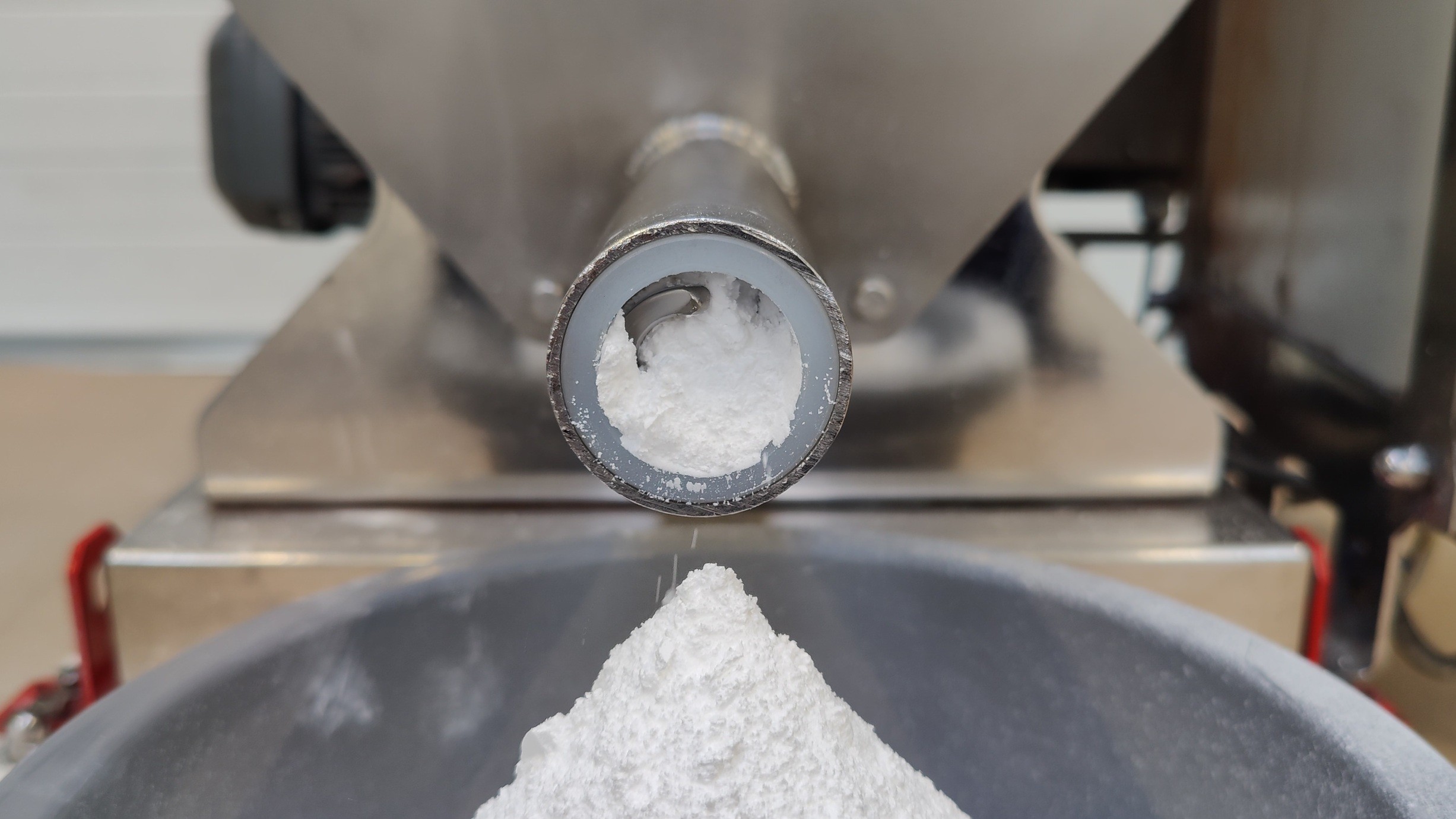
What volumetric feeding is
Economy built on constant volume per unit of time
Volumetric screw feeders are the most economical way to deliver bulk solids at a controlled rate. Unlike gravimetric systems, flow control rests on regulating the rotational speed of the feeding element — a screw with a guide shaft, or a spiral. Thanks to its simple design with no weighing system, the volumetric screw feeder carries a lower capital cost while still delivering repeatability of ±2–4% of setpoint after calibration.
The DSL V family works equally well as a standalone feeding system in continuous mode and as part of a batch preparation system. Importantly, every DSL V volumetric feeder can later be upgraded to a full gravimetric, loss-in-weight system by adding a load cell weighing assembly and a controller — without replacing the feeder itself.
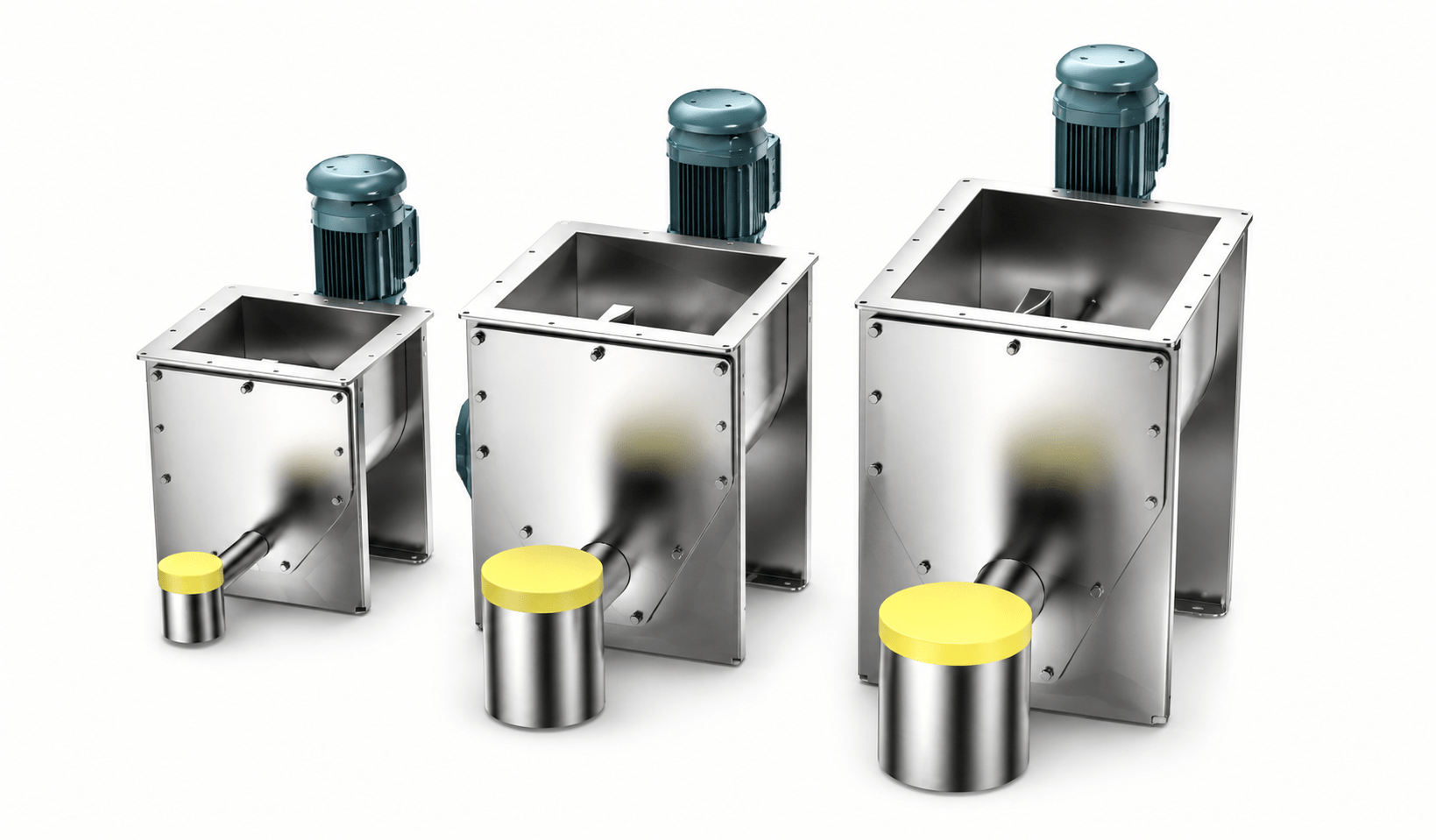
The DSL V feeder family
DSL35 V · DSL75 V · DSL150 V
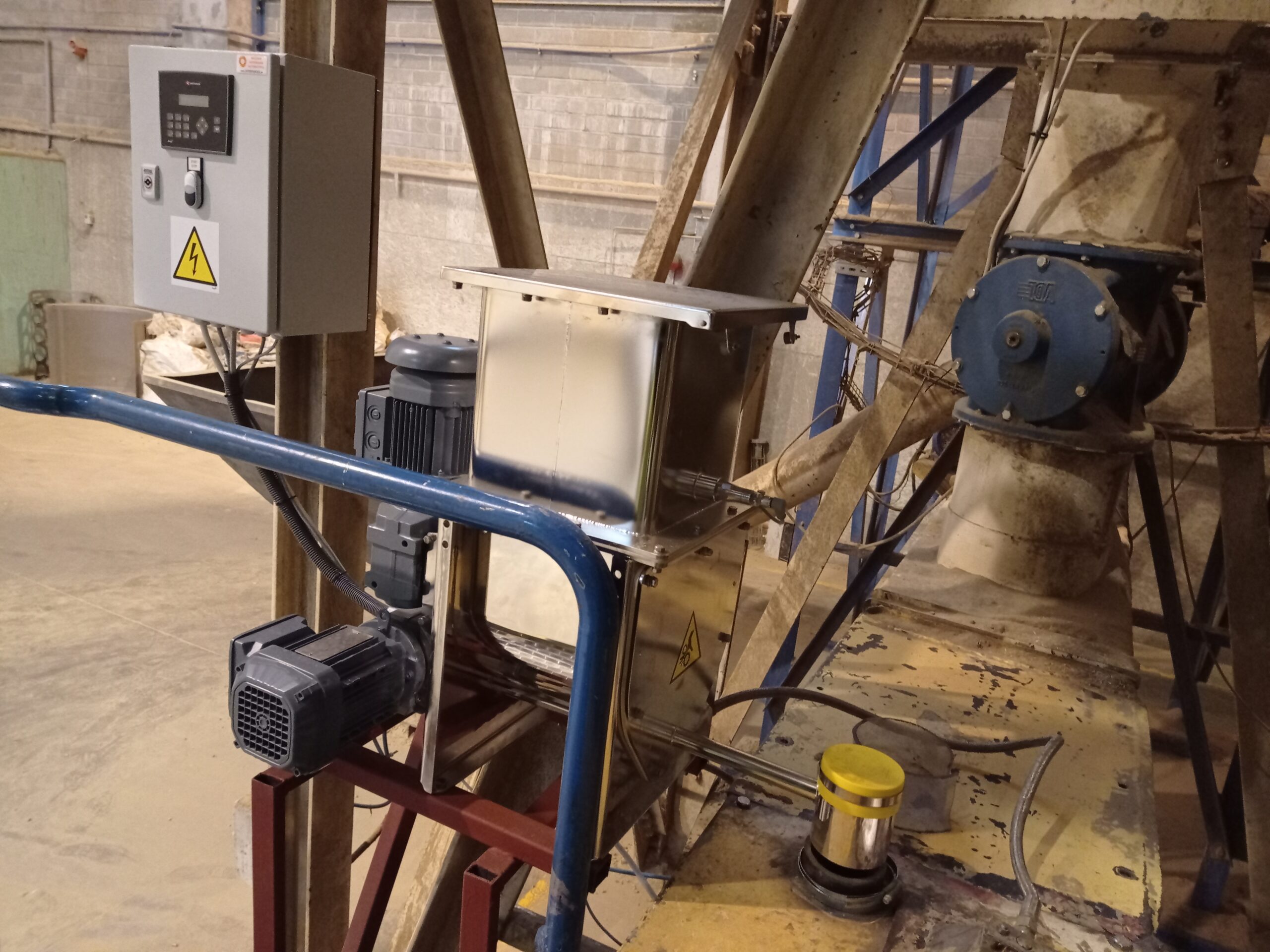
Screw feeder installations — click to enlarge
The DSL V volumetric feeder family comes in three sizes — DSL35 V, DSL75 V and DSL150 V — which between them handle bulk solids of widely differing character and particle size. The construction is entirely of stainless steel and includes a horizontal agitator on its own motor, which keeps the feeding screw evenly filled.
The feed rate is set by the rotational speed of the feeding element — a full-flight screw with a guide shaft, or a spiral (helix). The two are freely interchangeable, which widens the feeding range of a single unit.
Key DSL V specifications
- Accuracy
- max. error ±2–4% of setpoint after calibration
- Throughput
- from 0.5 to 25,000 l/h
- Turndown ratio
- 1:12 (min:max) on a single feeding element
- Feeding elements
- full-flight screw or spiral, ∅18–150 mm
- Hoppers
- chamber 12.5–60 l, extension hoppers 30–2400 l
- Drive
- SEW geared motor 3×400 V; options: 3×500 V, aseptic version, integrated frequency inverter
- Agitator
- horizontal, driven by its own motor
- Construction
- steel 1.4301 (AISI 304) or 1.4404 (AISI 316L)
- Surface finish
- electropolishing or glass bead blasting, continuous internal welds
- Options
- hygienic version, ATEX build, upgrade to a gravimetric system
- Intended for
- dry bulk solids — free and poor flowing, aerating, compacting
Downloads
Choosing the DSL V size
Three feeding chamber sizes cover the range from 0.5 to 25,000 l/h. Every feeding element gives a turndown ratio of 1:12 — full throughput tables for each screw and spiral diameter are in the data sheet.
| Model | DSL35 V | DSL75 V | DSL150 V |
|---|---|---|---|
| Throughput range | 0.5–450 l/h | 7–5,000 l/h | 70–25,000 l/h |
| Feeding elements | ∅18–35 mm | ∅35–74 mm | ∅74–150 mm |
| Rotational speed | 10–250 rpm | 10–250 rpm | 10–200 rpm |
| Chamber capacity | 12.5 l | 40 l | 60 l |
| Total capacity with hopper | 30 / 40 / 65 l | 100 / 200 / 300 l | 400 / 600 / 1200 / 1800 / 2400 l |
Choosing the feeding element
Spiral or full-flight screw?
The right choice of feeding element bears directly on how stable and repeatable the delivery is. Depending on the properties of the bulk solid we therefore use two types of screw, freely interchangeable to widen the feeding range.
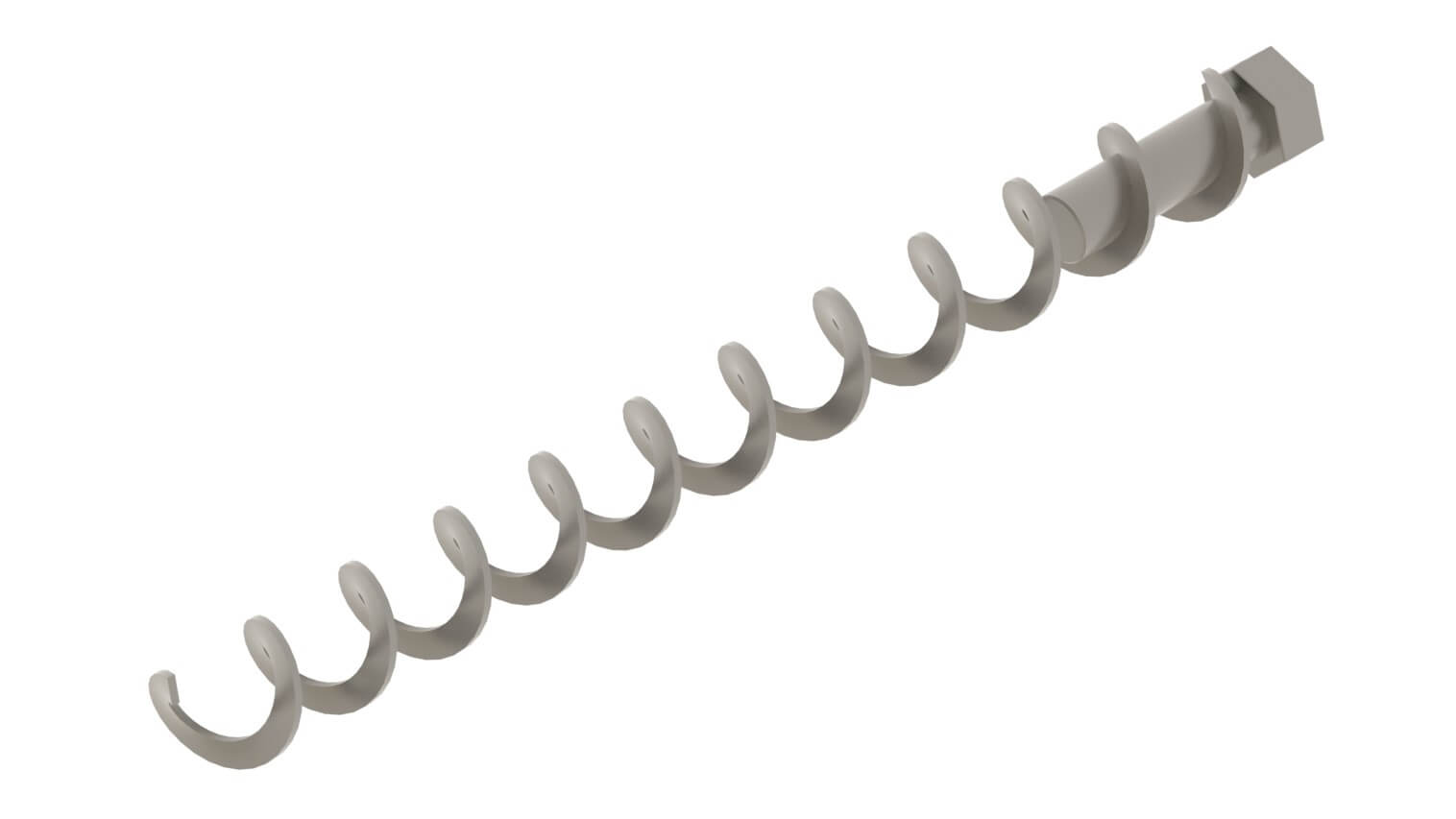
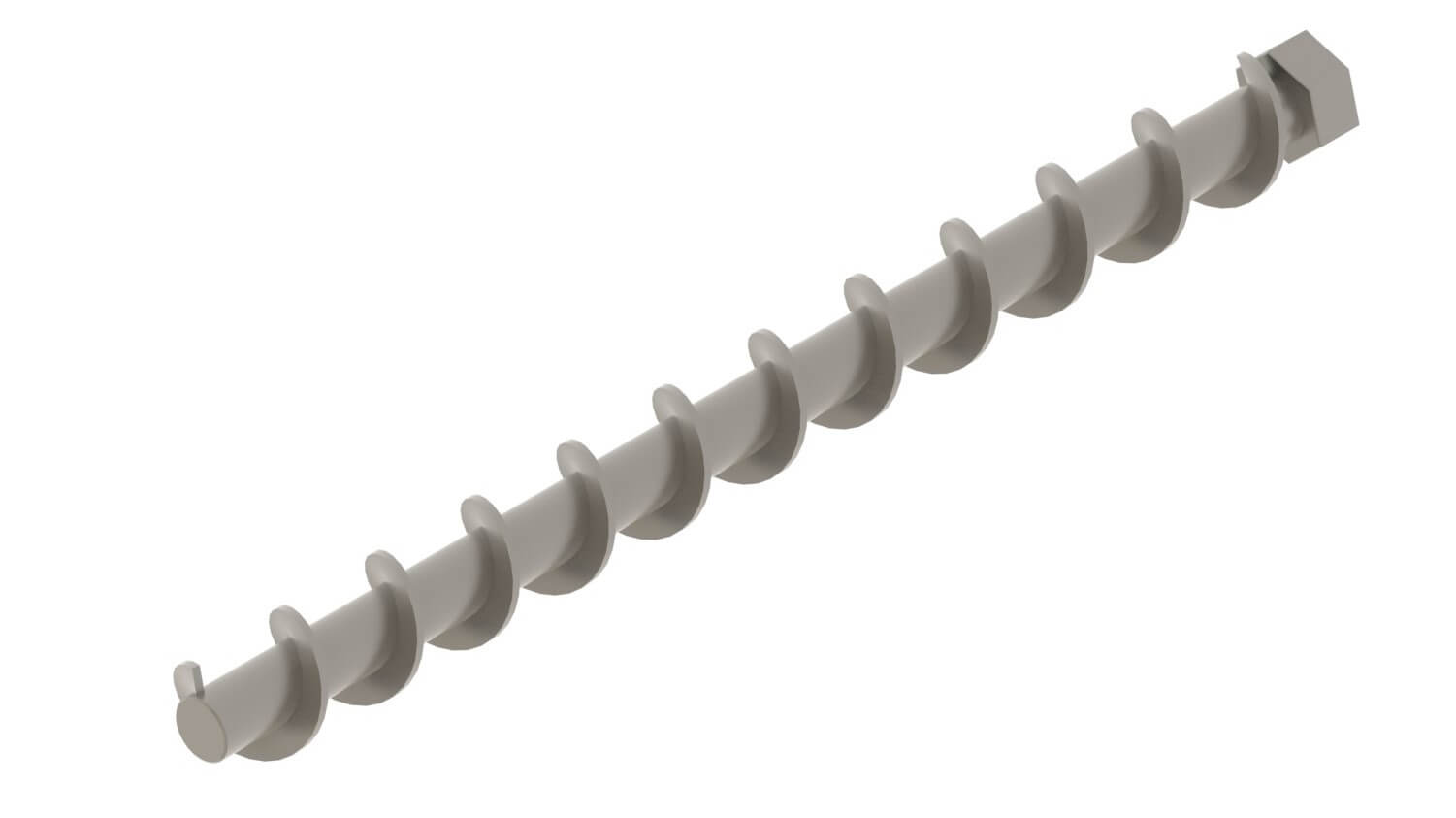
Not sure which element to choose? We run feeding trials on the customer’s own material — the choice of screw or spiral is confirmed by measurement, not by catalogue data alone.
Arrange a material trialVolumetric vs gravimetric
When should you choose a volumetric feeder?
A volumetric feeder is the best answer where the material has a reasonably constant bulk density and the accuracy demands are not as strict as they are for multi-ingredient recipes. It is also the usual choice as a feeder into a weigh hopper, a mixer or a pneumatic conveying system.
Where accuracy below ±0.5%, full traceability of mass flow or process validation (GMP) is required, we recommend the gravimetric DSL G instead. It is worth stressing, though, that any DSL V can be upgraded to the gravimetric version at any time.
| Criterion | Volumetric DSL V | Gravimetric DSL G |
|---|---|---|
| Measuring principle | Constant volume per unit of time | Continuous measurement of loss in weight (LIW) |
| Typical accuracy | ±2–4% of setpoint after calibration | <±0.5% of setpoint |
| Feedback loop | None (open loop) | PID controller (closed loop) |
| Compensation for density changes | ✗ Requires manual calibration | ✓ Automatic, in real time |
| Capital cost | ✓ Lower — simpler construction | Higher (weighing system plus controller) |
| Upgrade path | ✓ Can be upgraded to gravimetric | A full system from the start |
| Best suited to | Homogeneous materials, feeding into vessels, conveying | Multi-ingredient recipes, expensive raw materials, audits |
Principle of operation
How a volumetric screw feeder works
In a volumetric feeder the bulk solid passes from the hopper into the feeding chamber, from which the feeding element — a screw or a spiral — moves it on at a controlled rotational speed. The volumetric throughput depends directly on that speed and on the geometry and diameter of the feeding element. The horizontal agitator, driven by its own motor, keeps the screw evenly filled, which matters above all with cohesive and poor flowing materials.
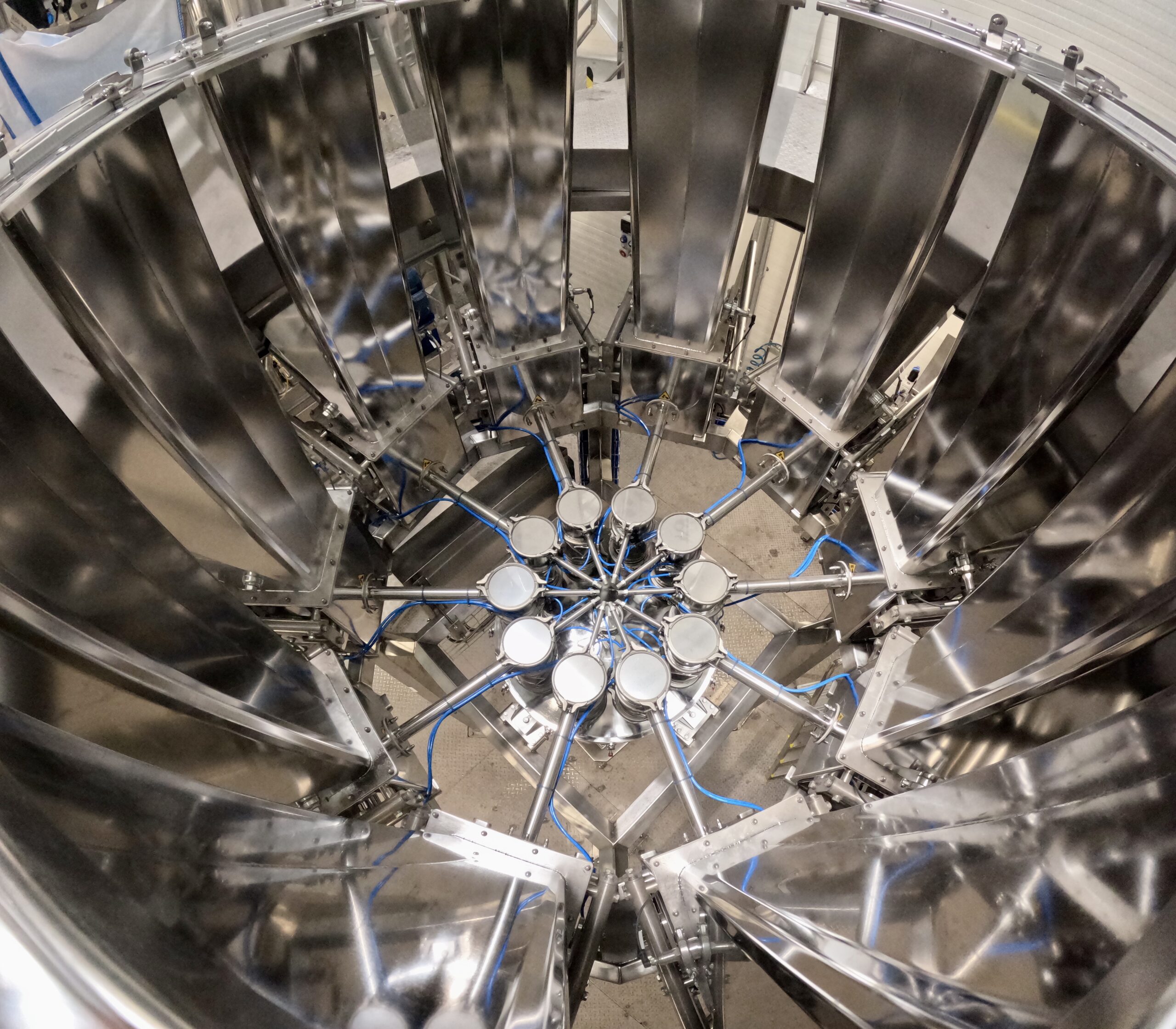
DSL V feeders are used in a wide range of process arrangements — as a feeder into a weigh hopper or a mixer, as part of a pneumatic conveying system feeding rotary valves, as a feeder on a packaging filling line, as a raw material feeder beneath a big bag discharge station, and as a standalone feeding system in simpler continuous applications.
Options and configuration
A feeder configured around the material and the process
We assemble every DSL V screw feeder from modules chosen to suit the properties of the bulk solid and the part the unit plays in the installation — from hopper capacity, through chamber geometry, to a hygienic or explosion-protected build.
Extension hoppers 30–2400 l
Hoppers of various capacities are available for every chamber, including shapes that ease material flow and round-section hoppers with an additional vertical agitator — for poor flowing and sticky materials.
Interchangeable feeding elements
Screws and spirals of different diameters and pitches can be exchanged freely within one unit — a quick way to change the throughput range when the product changes, and easy dismantling for cleaning between batches.
Batch feeding
A shut-off valve across the material stream allows batch operation: coarse feeding at full speed and fine feeding at reduced speed, with the cut-off point corrected from previous batches.
Hygienic build
Continuous welds inside and outside the structure, internal surfaces and welds ground to Ra<0.8 µm — for the food, pharmaceutical and cosmetics industries.
Drive train
A 3×400 V motor with an SEW worm gearbox; optionally a 3×500 V drive, an aseptic version, or a frequency inverter integrated with the feeding element gearbox.
ATEX build and other options
An Ex version for explosive atmospheres, a vertical outlet tube, and an upgrade to a gravimetric loss-in-weight system — without replacing the feeder itself.
Industries and applications
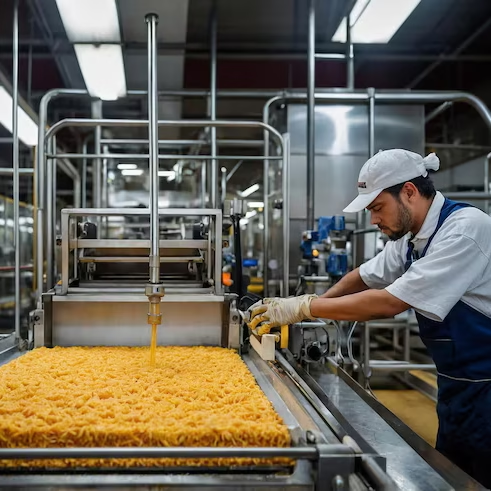
Applications in key industries


FAQ
Frequently asked questions
Why InterProcess
Why choose our solutions?
In-house manufacture
We design and build DSL V feeders in our own works.
An upgrade path
Every DSL V can be upgraded to the gravimetric DSL G version.
Complete delivery
From design through to commissioning and service.
Experience across many industries
Food, chemicals, pharmaceuticals, construction.
Safety and hygiene
Systems compliant with ATEX, HACCP and GMP.
Technical support and service
With a fast response, 24/7 if required.