InterProcess Sp. z o.o. | Solutions for industry


■ Manufacturer – Bulk Material Feeders – Big-Bag Stations – Pneumatic Conveying Systems ■ I optimize the handling of bulk materials & help automate weighing and feeding processes ▶ CEO and founder of InterProcess
May 17, 2026
Introduction — why big bag systems outperform conventional sacks
A topic that comes up frequently in conversations with our clients. While we are neither a bag manufacturer nor a strict production-strategy consultancy, we do build big bag discharge stations, and the question of “switching” to big bags is one we encounter daily.
The most expensive bag in your plant is not the biggest
The most expensive bag in a production plant is very often not the largest — it is the smallest. Because the cost of a 25 kg sack does not end with the packaging invoice. Add manual lifting, cutting, shaking out, dust, cleaning, disposal of plastic waste and — most often overlooked — the cost of the constraints this handling model imposes on the entire line.
I see this in practically every process audit we run at InterProcess: the moment a plant should reconsider switching to big bags arrives much earlier than the standard CAPEX spreadsheet suggests.
The scale of the problem in a single number
Let us assume that one base raw material is consumed at the rate of 500 t per year. In 25 kg sacks, that is 20,000 packaging units a year. Each one must be delivered, lifted, cut open, emptied, shaken out and set aside. After switching to 1-ton big bags, you are left with 500 units — forty times fewer manual operations.
This is not yet the whole picture. It is only the starting point.
Three hidden costs of small sacks
First — ergonomics. The NIOSH (National Institute for Occupational Safety and Health) lifting guidelines set 23 kg as the ideal reference load under optimal conditions. In a real production environment — with reaching, trunk twisting, lift height and repetition — the safe load drops considerably. A 25 kg sack already exceeds the ideal value by definition. EU Directive 90/269/EEC sets the minimum health and safety requirements for the manual handling of loads precisely where the risk of back injury exists, and musculoskeletal disorders remain the most commonly reported occupational disease across the European Union. With realistic workstation geometry, the corrected NIOSH Recommended Weight Limit (RWL) typically drops to 10–14 kg — well below the nominal sack weight.
In practice this means: rising absenteeism, higher insurance premiums, pressure from EHS — and increasing difficulty in finding operators willing to do the work.
Second — dust. Manual sack emptying always generates dust emissions in the operator’s breathing zone. For reactive, cohesive, irritating materials or those with a low minimum ignition energy, the cost of this dust grows exponentially: from straightforward EHS, through ATEX, to product quality and the risk of cross-contamination. Various extraction systems, personal protective equipment and, in some solutions, full workstation enclosure (e.g. glove boxes) — everything that is built today around a problem that big bags with dust-tight docking largely solve at source.
Third — the cost of every repetitive task. Taking a very conservative 30–60 seconds to open and empty a single 25 kg sack, the same 500 t per year from our example generate 167–333 hours of operator time spent solely on a repetitive, low-value task. Eurostat estimated average hourly labour costs across the EU at around €35 in 2025, with substantial variation between Member States (e.g. around €19 in lower-cost economies). Before counting cleaning, waste, dust and downtime, manual handling alone already costs €5,700–11,300 per year at the EU average — for a single raw material.
In most production lines there is more than one such material.
On the investment side — a BSB discharge station in its basic configuration typically falls in the €15,000–20,000 range, with a more advanced configuration (full hermetic docking with filtration, pneumatic massagers, integration with dosing or pneumatic conveying) in the €25,000–70,000 range. For a plant running 5–8 base raw materials in 25 kg sacks, simple payback typically falls within 1–3 years — before any hidden costs (absenteeism, cleaning, product quality) are accounted for.
To this we add an increasingly central argument: 1-ton big bags typically generate 3–5× less packaging waste per ton of product than 25 kg sacks, while reusable bags cut the packaging footprint by a further 60–80%. For plants with a formal sustainability target or non-financial reporting obligation under the CSRD Directive, this argument now lands on the same slide as the payback period.
Where big bags actually pay off
Before we move on to station design, it is worth asking honestly: is the big bag the right answer for this raw material at all? For consumption above approximately 2,000 t/year of a single material, bulk delivery by tanker into a silo with pneumatic or mechanical conveying is often cheaper — no packaging cost, lower net material price, no waste disposal. Big bags typically win in the 100–2,000 t/year range of a single raw material when recipe variability rules out a dedicated silo, when the plant lacks the space or budget for an external silo, or when the supplier simply does not offer bulk deliveries. Outside this window the maths stops adding up — and it is worth knowing where the window begins.
What you really buy when you buy a big bag discharge station
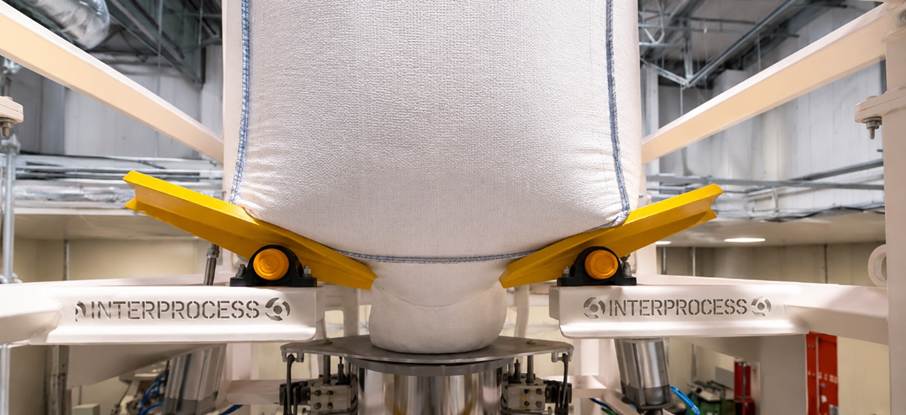
The key moment of misunderstanding in our client conversations starts here: a big bag station is not “a frame with a bag”. It is process architecture. And it is the architecture — not the price of the supporting structure itself — that determines whether the investment genuinely relieves production, or merely shifts the problem a few metres downstream.
A well-designed station has four independent decision layers:
1. Bag handling method. Forklift, external gantry crane, integrated electric hoist, low-profile design for plants with restricted headroom. Each option entails a different layout, a different CAPEX, and a different operational logic per shift.
2. Discharge interface. This is where good stations separate from poor ones. Dust-tight docking with adjustable clamping pressure, a double-ring sealing module, an inflatable seal for additional certainty, a glove box for high-risk applications, an extraction fan compressing the bag before removal. This is where it is decided whether the operator works in dust, or beside it.
3. Flow assistance. This is the area where most implementations fail. For cohesive, lumping, moisture-sensitive or poorly flowing material, gravity alone is not enough. The station designer has at their disposal: pneumatic massagers (lower or side-mounted — the latter, rhythmically squeezing the sides of the bag, known in the industry as “boxers”), vibrators, spout stretchers, lump breakers and, in extreme cases, top-down extraction with a suction lance. Each of these solutions works in a different material class. For sensitive and clearly cohesive materials, pneumatic massagers often outperform vibration because they break bridges without consolidating the powder and without risk of particle attrition. For free-flowing materials (PE/PP pellets, dry silica sand, granulated fertilisers), vibration on a rest plate is cheaper and sufficient.
4. Integration with the rest of the installation. The station itself is only half of the answer. The other half is the dosing system, pneumatic transport (dilute or dense phase) or mechanical conveying and, more broadly, feeding into a mixer, reactor or weighing system. The real value of the project does not lie in “emptying the bag” alone, but in what happens to the material through the subsequent process stages.
Six promises now expected of a good station
If we boil down management and maintenance expectations to a single denominator, a good station today must deliver six things: dust-free operation, operator safety, modularity, the ability to handle difficult materials, ease of cleaning and integration with dosing and conveying. What distinguishes premium solutions from baseline ones is the perfect fit to application requirements and space constraints, an extensive range of options improving discharge reliability, integration with the dosing system, and compliance with high hygiene and safety standards — in food applications in accordance with EHEDG guidelines, in pharmaceutical applications in accordance with EU GMP requirements (Eudralex Volume 4) and where relevant FDA 21 CFR Parts 210/211, in dairy in accordance with 3-A Sanitary Standards, and in explosive atmospheres in accordance with the ATEX Directive 2014/34/EU.
Where the pitfalls are
It must be stated clearly: big bags are not a good solution “by default”.
The implementation pitfalls are just as repeatable as the benefits:
- Basics. Ceiling height, forklift access, room to manoeuvre a full big bag, the logic of an integrated hoist versus a plant crane, certification of the hoist under applicable national lifting-equipment regulations (e.g. periodic inspection by the relevant national authority), adequate floor load capacity, reliable big bag supply. These are matters to think through before, not after, purchasing the station.
- Material that “won’t flow on its own”. Cohesive, moisture-sensitive, lumped powders with a low internal friction angle require specific, empirically selected flow assistance. Vibration alone is often insufficient — and for sensitive materials it can actively degrade quality and hinder discharge. In such cases massagers are essential, and not only the standard lower ones but also side-mounted ones. Sometimes it is also worth investing in an automatic spout-tensioning system to avoid wrinkles that obstruct flow.
- Partial discharge and precision dosing. If the process requires batch or continuous dosing, full gravity emptying is not enough. A dosing device and weighing system must be provided, and this is critical for the final station design. In some applications a pinch valve on the bag spout is also necessary if partial removal of a partially filled big bag may occur.
- Bag specification. Far too many implementations hit a wall because the station is designed before establishing exactly which bag will arrive at it. Industry guidelines for big bags are unambiguous here: you must define the SWL (safe working load), the safety factor (per ISO 21898 typically 5:1 for single-use bags and 6:1 for multi-use bags and UN-certified bags for hazardous materials), the top filling type, the bottom discharge type, the presence of a liner and — for explosive atmospheres — the correct bag type per IEC 61340-4-4 (Type A — standard, with no electrostatic protection; B — limited to materials with a minimum ignition energy above 3 mJ; C — conductive, requiring earthing; D — dissipative, no earthing required). Getting the last point wrong is not a matter of cost — it is a matter of safety.
- Multi-component recipes. If a plant works with a large number of raw materials but some of them are minor additives, full migration to big bags makes no sense. The most sensible approach is often a hybrid model: big bags for base materials and a classic sack station for additives. Premix preparation in big bags, fed from small sacks via more or less automated dosing systems, is also a common pattern.
Five questions to ask yourself before investing
Before management approves CAPEX and the process engineer begins writing the specification, it is worth closing five questions:
- How many sacks do we actually open per shift today, and how long does it take? Not a desk estimate — a real observation on the line.
- Does our material tend to bridge, lump or dust excessively? And if so — have we already tested it in big bags?
- Do we need full discharge, or also dosing? Because this completely changes station configuration.
- What bag exactly will arrive at us? Maximum load, liner, spout type, electrostatic requirements, dimensions.
- How is the material to enter the rest of the process? Gravity into a hopper, a conveyor, through a dosing device, into pneumatic transport, a lump breaker, a weighing system?
Answers to these five questions decide 80% of implementation success. The rest is mechanical design and automation — the part that is solved at the engineering stage.
Why “designing for the customer” is not a marketing slogan here
In bulk material handling, every plant is different: different material, different layout, different product mix, different team skills, different quality requirements. That is why at InterProcess we never sell “stations off the shelf”. In practice, almost every BSB big bag discharge station project is tailored to the specific application: from the support structure with an option for an integrated hoist, through the discharge assistance system — a rest plate with a vibrator or a pneumatic massager module selected to suit the material, a double-ring polished stainless-steel dust-tight docking module, up to integration with a screw feeder and pneumatic conveying.
For some clients this means a fully hermetic version with HEPA filtration for toxic materials. For others — a hybrid model combining the BSB station with our classic STB sack tipping station. For others still — full integration with an existing weighing and plant-control system.
The components are always the same — proven, European — with full CE certification and, where required, certification under applicable national lifting-equipment regulations. The process architecture — different every time.
A representative example from our practice: a food additive producer with annual consumption of several hundred tons switches from 20–25 kg sacks to 500–600 kg big bags with a station featuring double-ring dust-tight docking, massagers, integrated weighing and a screw feeder. The main drivers are then not purely financial — they concern compliance with the end customer’s cross-contamination audits, reduction of team absenteeism and batch traceability. The payback period in such projects typically falls within 12–24 months, but the real value is often qualitative: retaining the contract with a major customer whose audit standard has just tightened.
Finally — a very practical test
If your production today depends on small sacks of base raw materials, count not the packaging price, but the cost of every repetitive task an operator performs hundreds or thousands of times a month. Add to that dust, cleaning, absenteeism and constraints on line expansion.
That is where the real business case for big bags usually starts.
And it is from calculating that case — not from a commercial offer — that the conversation is worth starting.
If you have a question about a specific application or a material that is not easy to handle today, please get in touch. The most interesting projects usually begin with ten minutes of an honest conversation about what is really happening on the shift floor.
👉 Product page: interprocess.pl/de/big-bag-entleerung/