InterProcess Sp. z o.o. | Solutions for industry

What dust-free big bag discharge is
Discharge without dust, losses or risk to the operator
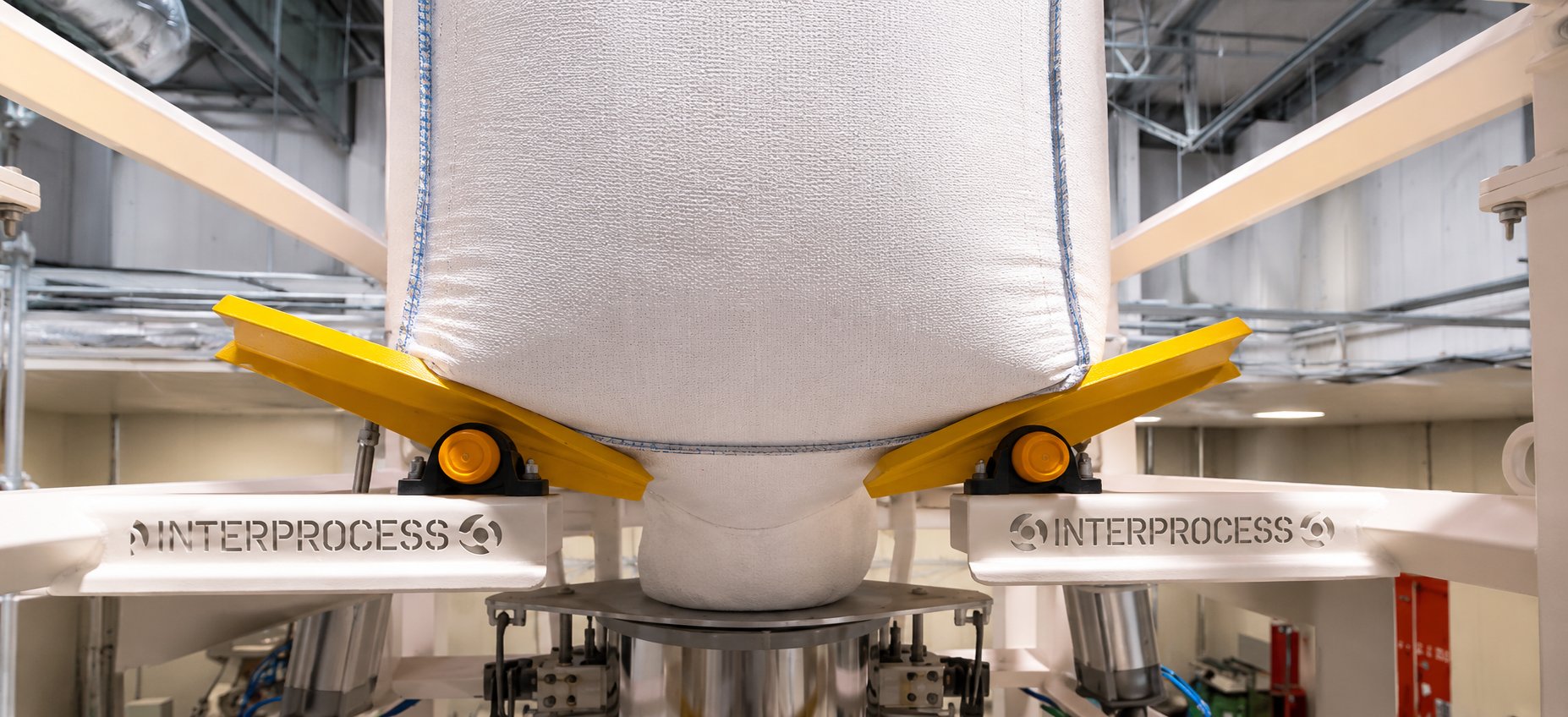
Emptying big bags by hand means dust in the plant, losses of expensive raw material, a risk to operators’ health and no control over how much material has been issued. BSB discharge stations, also called big bag emptying stations or bulk bag unloaders, enclose the whole process in a sealed, dust-tight system: from lifting the bag to discharging the material into the process.
Unlike catalogue products, every station is designed from the ground up: an integrated electric hoist on an overhead rail does away with the fork-lift truck, pneumatic massagers assist the flow of poor flowing materials without disturbing their structure, and the dust-tight docking module seals the bag to the station. The modular construction allows the station to be extended later, as process requirements change.
The BSB station in brief
- +Dust-free emptying of big bags weighing up to 2,000 kg and up to 2500 mm tall
- +Loading by integrated electric hoist on an overhead rail, or by fork-lift truck
- +Flow aids: pneumatic massagers, a support table with a vibrator, spout stretching
- +A dust-tight, double-ring docking module with adjustable lid pressure
- +ATEX, FDA, GMP and HACCP builds; painted carbon steel or AISI 304 / 316L
- +Integration with feeders, pneumatic conveying and the plant control system
The BSB discharge station
A structure tailored to the application
BSB station installations (click to enlarge)
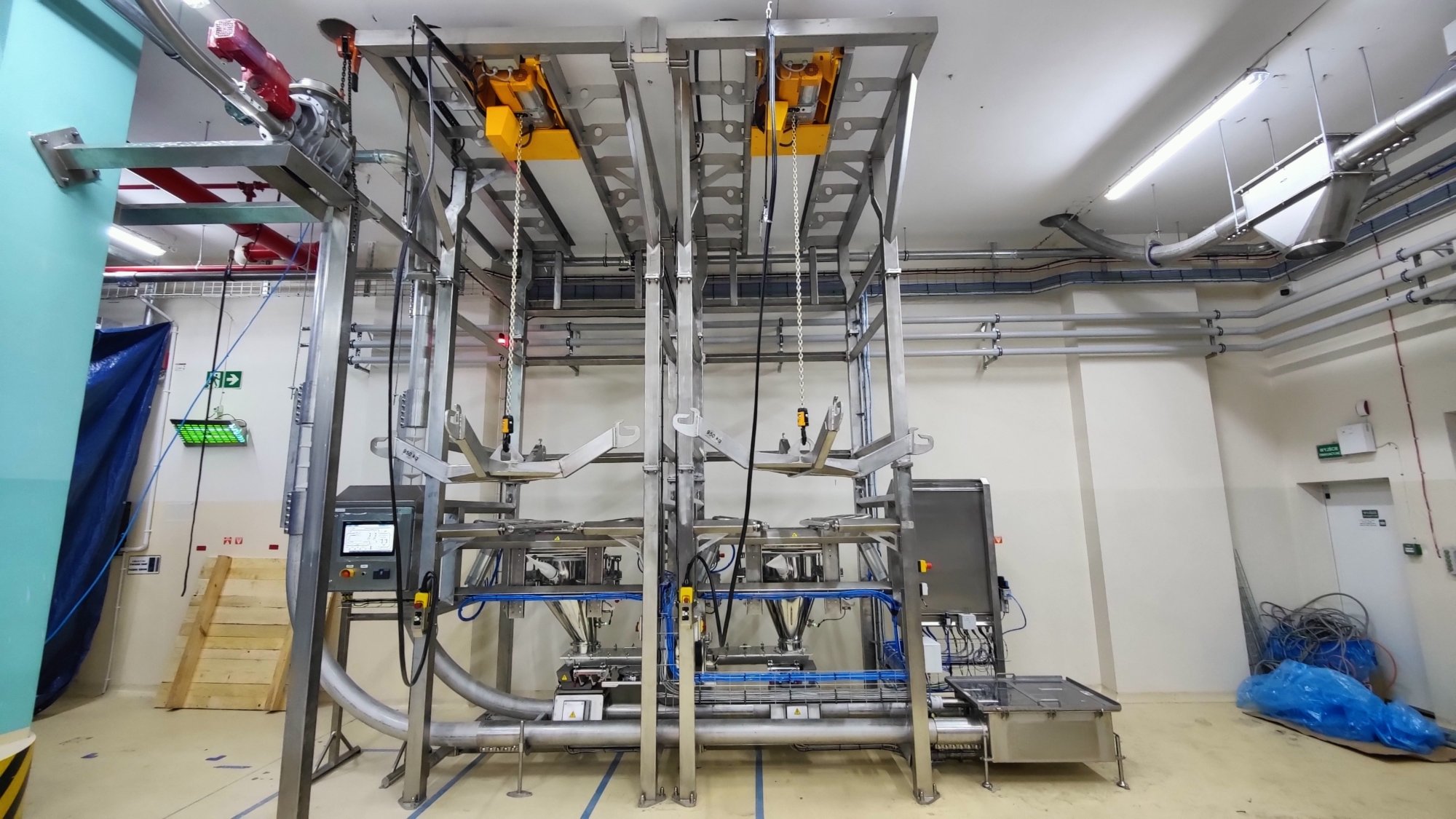
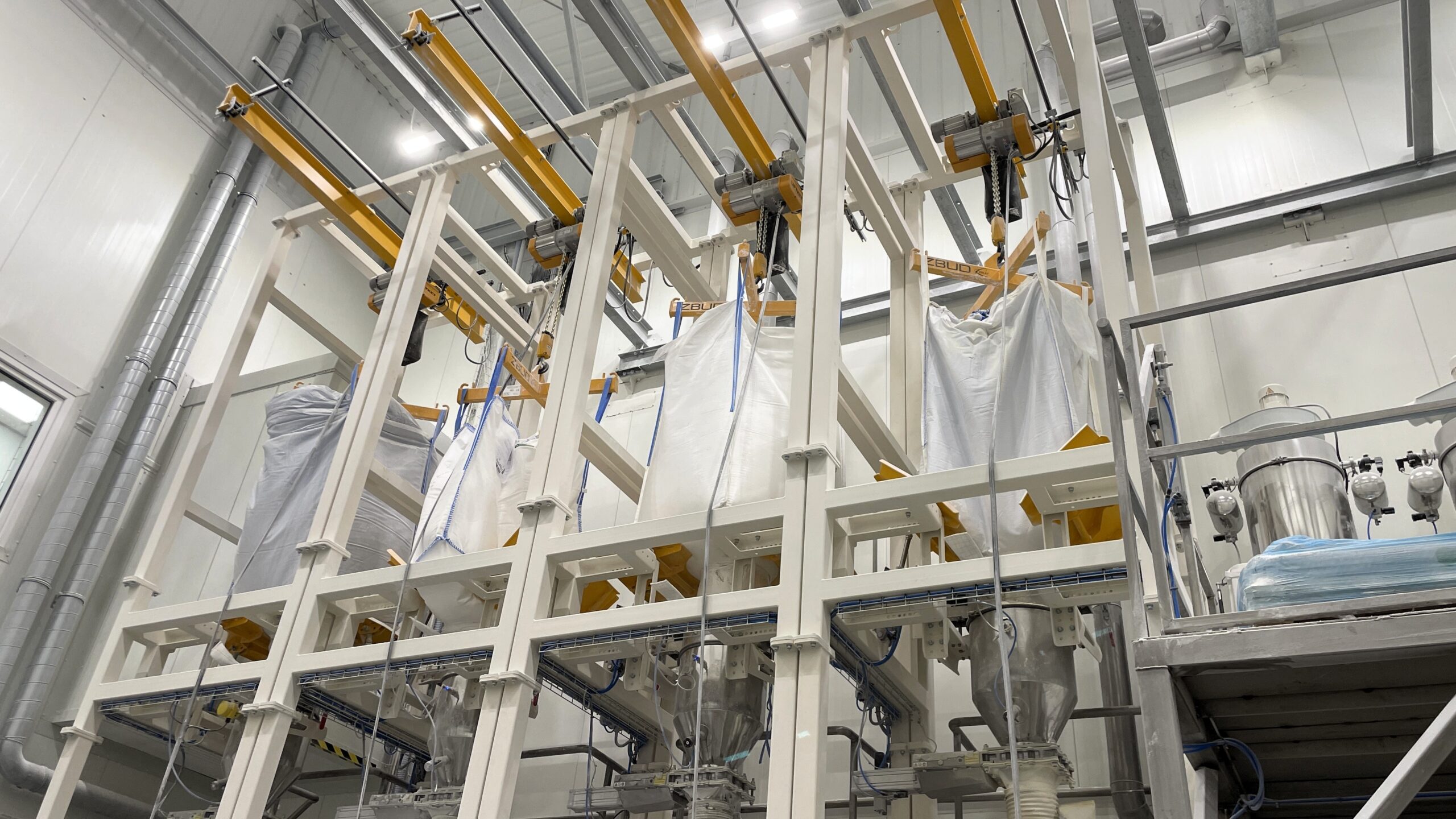
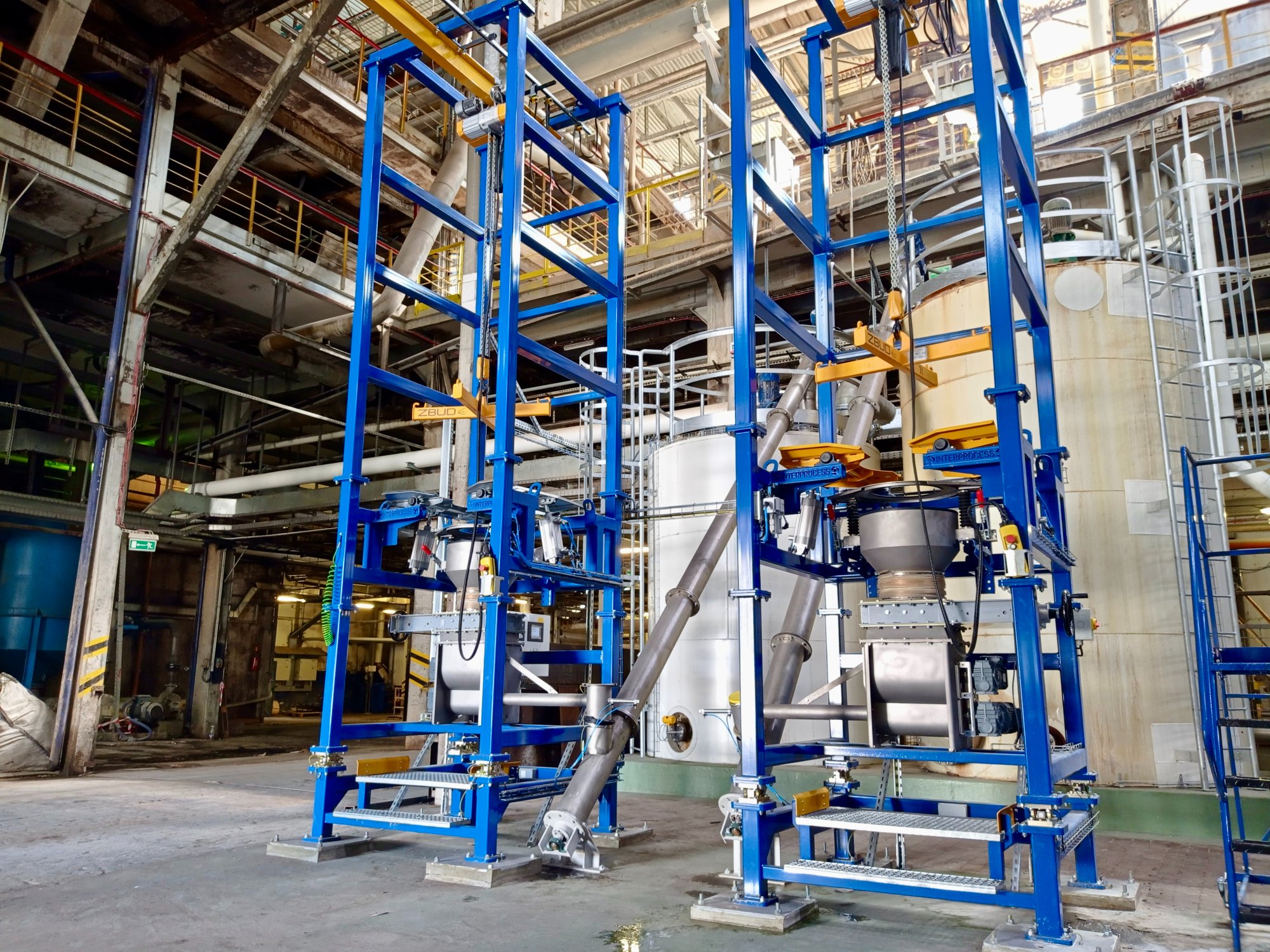
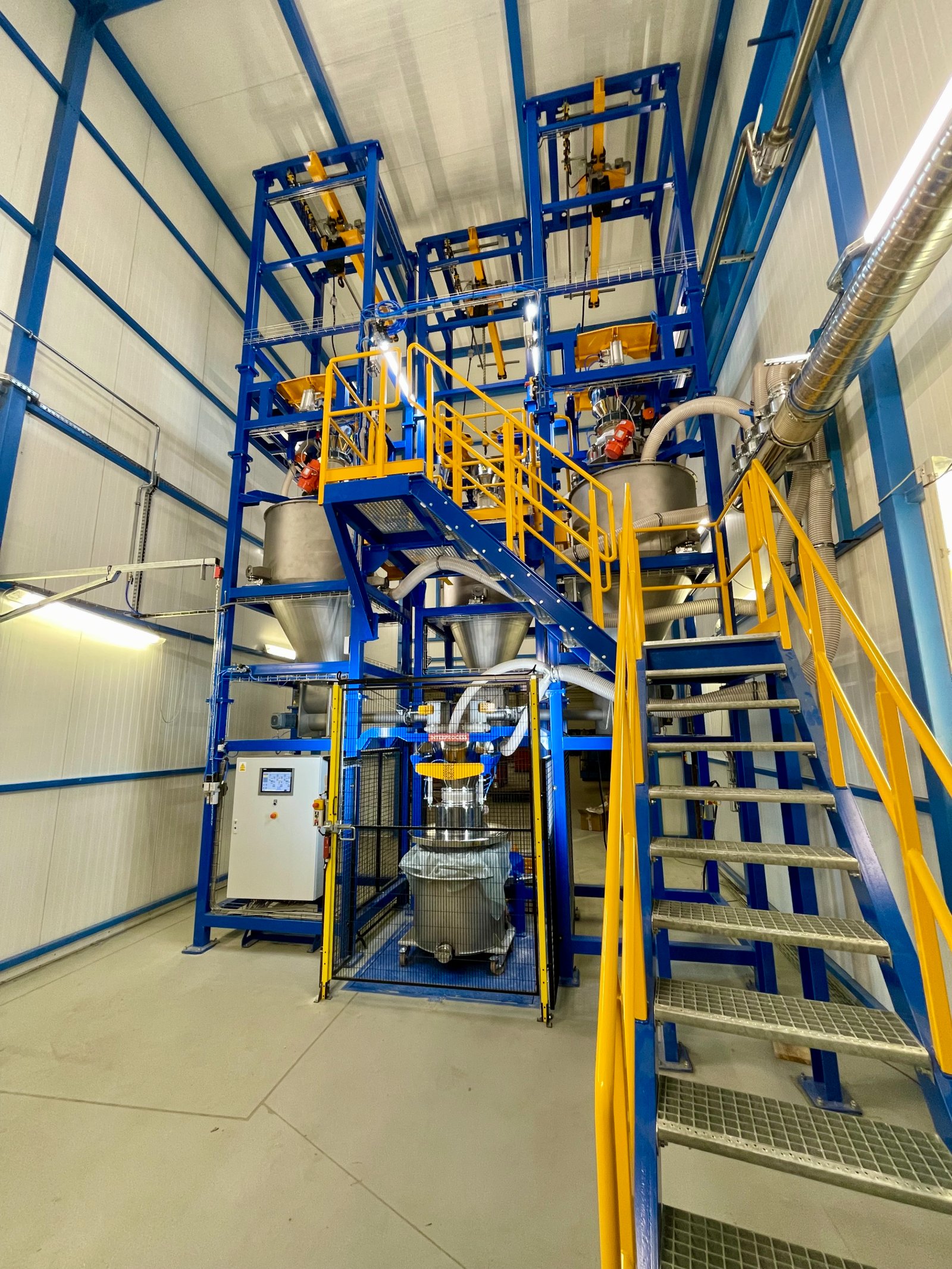
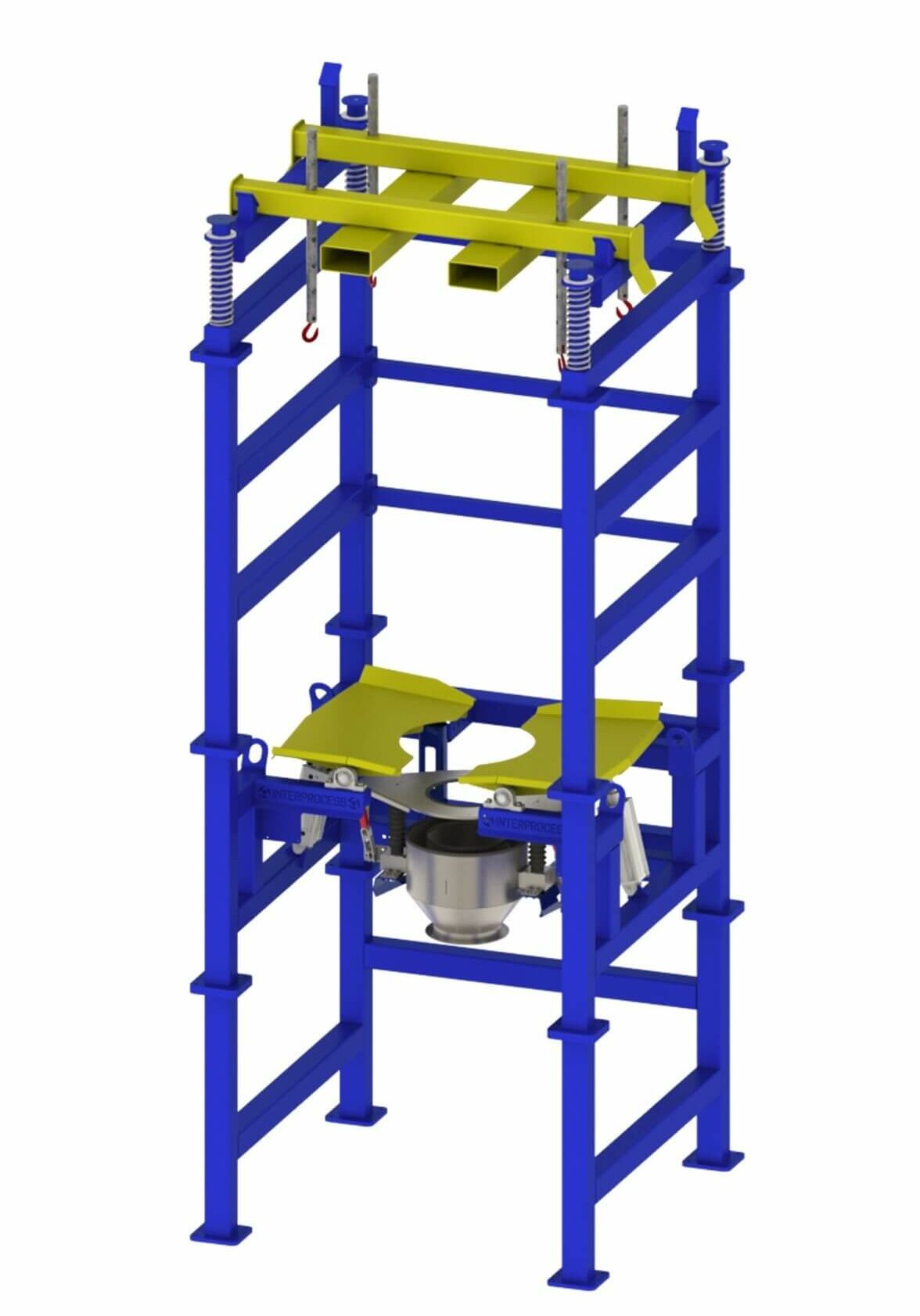
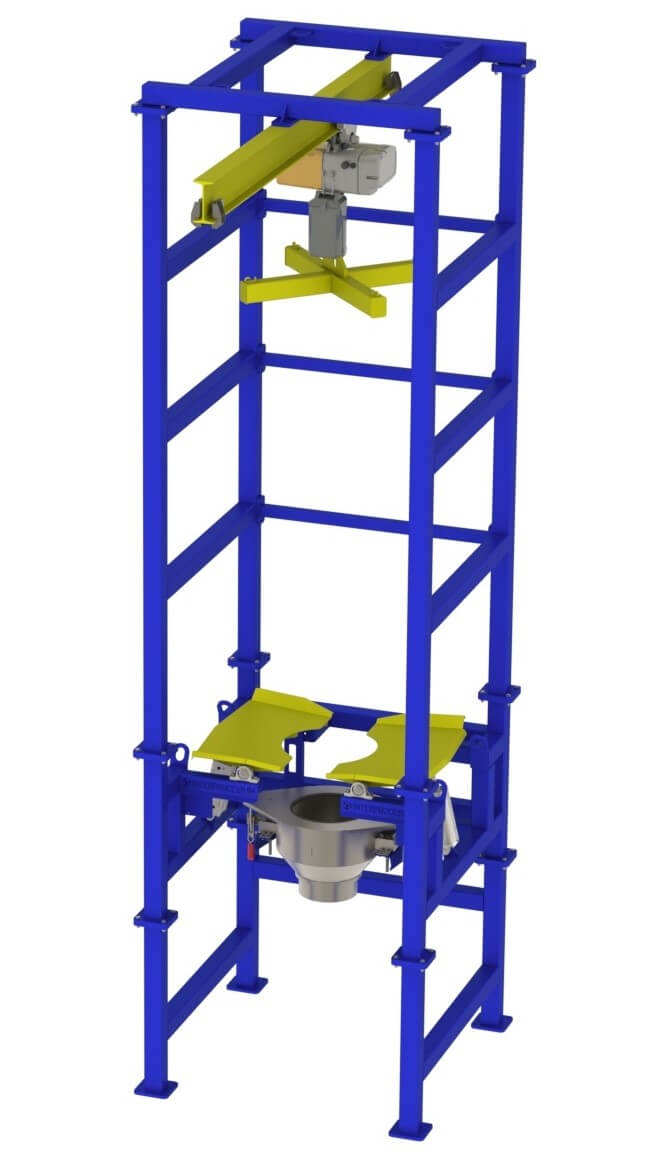
A BSB station consists of a supporting frame, a bag loading system, a flow aid system and a dust-tight docking module. We match the frame dimensions, the lifting capacity and the equipment to the size of the bags, the properties of the material and the space available. We do not offer a single standard model.
The frame is of powder-coated carbon steel or, in the hygienic build, of AISI 304 / AISI 316L stainless steel. Every part in contact with the material is always stainless steel.
Key BSB station specifications
- Lifting capacity
- up to 2,000 kg (lifting frame carrying the bag’s 4 loops)
- Bag height
- up to 2500 mm
- Frame
- approx. 1500 × 1500 mm; height matched to the application
- Hoist beam
- 2800 mm long, lifting capacity 1,000 or 2,000 kg
- Materials
- powder-coated carbon steel; AISI 304 / AISI 316L optional
- Parts in contact with the material
- always AISI 304 or AISI 316L stainless steel
- Docking module
- double-ring, dust-tight, with adjustable lid pressure
- Options
- load cell weighing, dust filter, pneumatic spout closing, automatic bag tensioner, liner tensioner, roller conveyor, disposal of empty bags
- Builds
- ATEX (dust or gas zone), hygienic FDA / GMP / HACCP
Downloads
How the bag is loaded
Integrated hoist or fork-lift truck?
The BSB station comes in two loading variants: with an integrated electric chain hoist on an overhead rail, which forms part of the station, or in a version loaded by fork-lift truck. Both use the same frame, lifting frame and docking module.
| Criterion | Integrated hoist on an overhead rail | Fork-lift loading |
|---|---|---|
| Handling the bag | The operator raises the bag at the push of a button; the trolley guides it along the beam exactly over the docking point | The bag is brought in from above on the forks with a lifting frame |
| Operator safety | ✓ Lifting from the side or the rear of the station, with no crushing risk | Manoeuvring a heavy truck in the working area |
| Space required | ✓ Less, with no manoeuvring area for a truck | An additional manoeuvring area beside the station |
| Risk of damage | ✓ The forks never touch the structure | The frame can be damaged by the forks |
| Capital cost | Higher (hoist and travelling gear are part of the station price) | Lower, since it uses the plant’s existing equipment |
| When to choose it | Frequent bag changes, restricted space, high safety requirements | Occasional discharge, with a truck and manoeuvring space available |
The higher-safety option
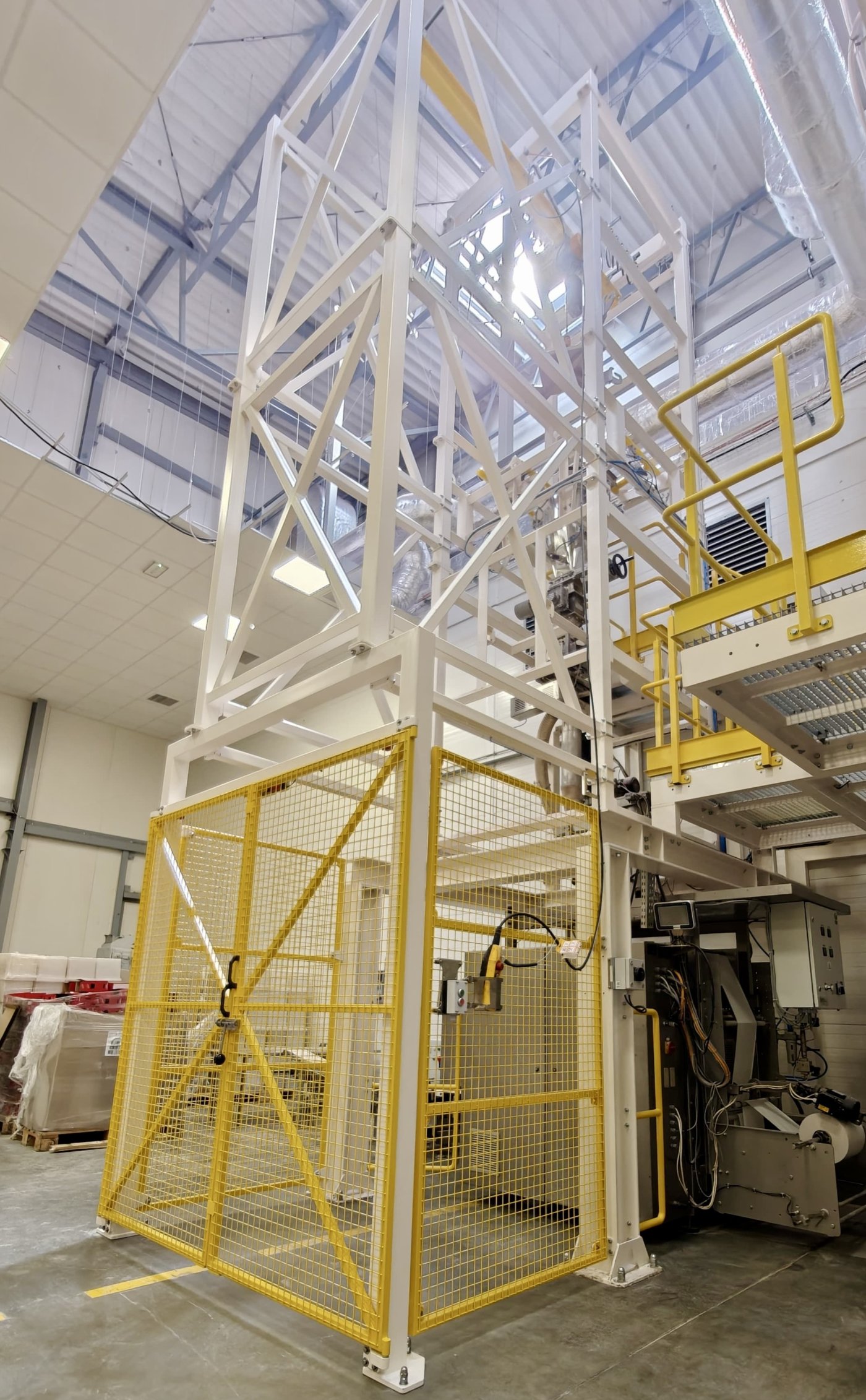
A loading-area enclosure with interlocked doors
Raising the bag and carrying it over the station is the most dangerous moment of the whole operation. A load of as much as two tonnes travels overhead, and loops hung wrongly or damaged fabric can let the bag fall. It is therefore worth enclosing the bag’s whole path in a guard that nobody can enter while it is moving.
The optional loading-area enclosure is a full-height panelled mesh guard with doors that are electromechanically interlocked with the hoist controls. The interlock works both ways: the hoist cannot be started while a door is open, and the doors stay locked until the bag has been set down safely in the docking position. The control pendant is brought outside the guard, so the operator handles the bag from beyond the danger zone. More and more customers ask for this, not least as part of a risk assessment and of the machine’s conformity documentation.
- 01Doors locked while the bag is raised and travels, with no access beneath a suspended load
- 02The hoist locked out while a door is open, through the mutual interlock of the two functions
- 03Controls and the emergency stop outside the guard, within the operator’s reach
- 04Full-height panels, with the guard shaped to the station’s footprint and to the access to the docking module
- 05Drives below the discharge point, such as a feeder or conveyor, cut off when a door opens
Flow aids
Massagers, a vibrator or spout stretching?
Bulk solids compact inside the bag during transport and storage, forming bridges and rat-holes that stop the material flowing. We match the flow aid system to the properties of the material, not the other way round.
Pneumatic massagers
Poor flowing materials
- +gently massage the material, breaking up bridges and rat-holes
- +leave the structure of delicate products intact — granules, flakes, crystals
- +transmit no vibration to the structure, which means less noise and lower fatigue loading
- +low energy consumption, minimal maintenance
Support table with a vibrator
Moderately flowing materials
- +the bag rests on a vibrating table, which fluidises the material
- +a simple, proven and inexpensive solution
- +sufficient for materials without strong cohesion
- +selected individually to suit the product
Spout stretching device
Stretching the bag spout
- +tensions the bag spout, keeping the discharge cross-section fully open
- +improves flow and empties the bag completely
- +improves hygiene, since the spout does not hang into the flow of material
- +an automatic tensioner keeps the bag taut throughout emptying
- +combined with massagers or a vibrator in one station
Flow aid selection table
| Character of the material | Recommended flow aid |
|---|---|
| Free flowing: granules, granulated sugar, pellets | None, or a support table with a vibrator |
| Moderately flowing, slightly caking: sugar, salt, groats | Support table with a vibrator, optionally a bag tensioner |
| Cohesive and dusty: flour, milk powder, pigments, lime | Pneumatic massagers with a spout stretching device |
| Delicate, easily damaged: flakes, granola, blends | Pneumatic massagers at reduced force, with no vibration |
| Heavily caked after long storage | Massagers and spout stretching, with a lump breaker below the discharge if needed |
The table is a guide. We confirm the final choice on a sample of the actual material.
Not sure which flow aid to choose? We confirm the choice from the properties of the customer’s actual material — particle size, cohesion and tendency to cake — not from catalogue data alone.
Ask about selecting a BSB stationDust containment
The dust-tight docking module
The heart of the BSB station is the double-ring docking unit. The operator opens the lid, draws the bag spout through the inner ring and closes the lid, forming a dust-tight connection. Only then is the spout opened and the material flows within a closed system.
The pressure of the docking lid is adjustable, which allows the seal to be matched to spouts of different types and sizes. The station can optionally be fitted with dust extraction at the rear and a connection to the plant’s central dust extraction system.
- Bag connection
- double-ring, dust-tight, with adjustable lid pressure
- Spout closing
- a pneumatic closing system that allows partial emptying and the storage of part-used bags
- Dust extraction
- optional extraction at the rear, or a filter integrated into the station; it draws dusty air out of the bag before it is removed
- Control of material consumption
- optional weighing of the bag on load cells
Integration with the process
Part of a larger system, not a separate machine
The lower frame of the station is adapted to the requirements of the installation, which makes the discharge station an integral link in the process line: from receiving the raw material, through feeding and conveying, to delivering the material into the process. We offer full design support in selecting the interface and the associated equipment.
Industries and typical materials
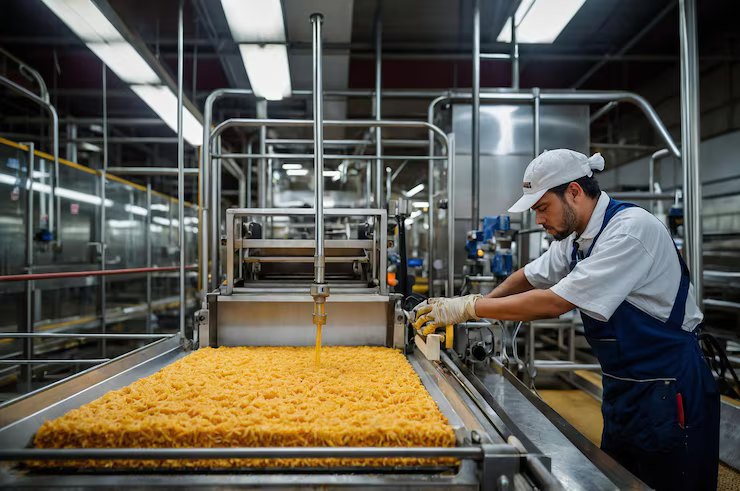
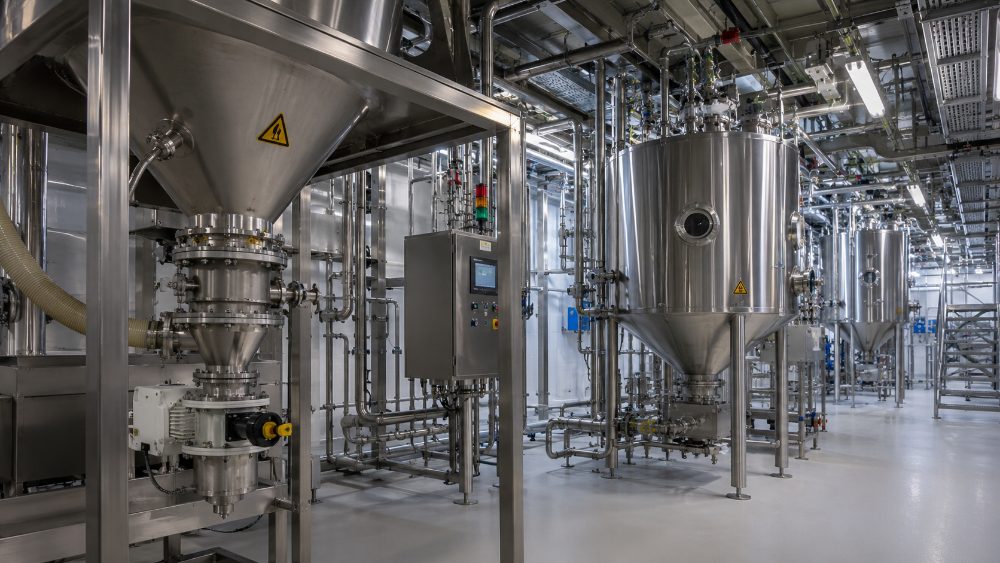
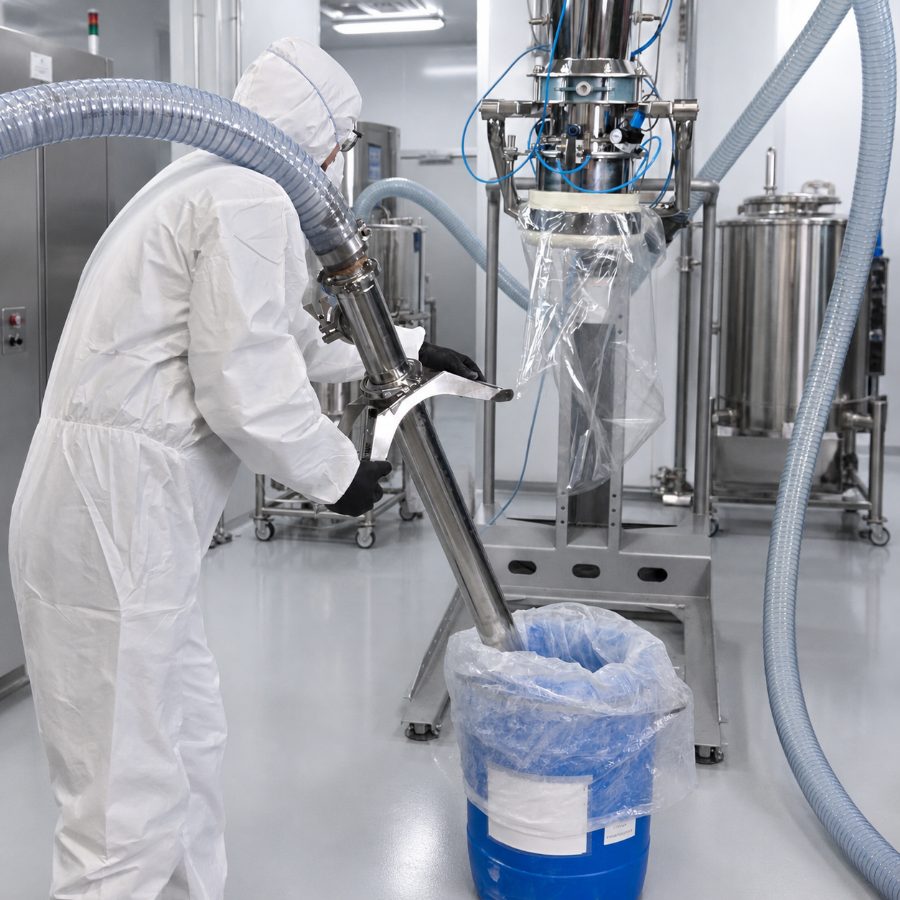
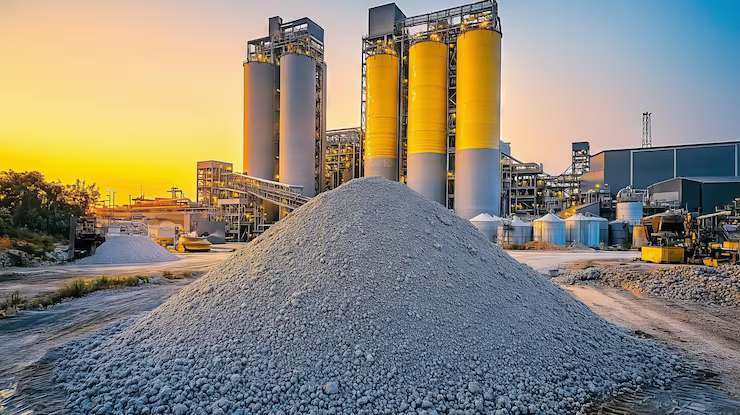
Applications in key industries
FAQ
Frequently asked questions
Why InterProcess
Why choose our solutions?
A tailored structure
Every station designed from the ground up for the customer’s application.
Dust-free handling
A dust-tight docking module with adjustable lid pressure.
Integration with the process
Feeders, pneumatic conveying, weighing, controls.
Experience across many industries
Food, chemicals, pharmaceuticals and construction.
Safety and hygiene
ATEX, FDA, HACCP and GMP builds, and guards with interlocked doors.
Technical support and service
With a fast response, 24/7 if required.