InterProcess Sp. z o.o. | Solutions for industry

Big bag systems · Bag filling
BSA big bag filling stations
Dust-free filling of FIBC bags weighing up to 2000 kg. Two levels of automation, BSA‑V1 and BSA‑V2, each configured individually: a sealed bag neck, a dust extraction system, weighing with OIML R61 verification, and full integration with the line controls.
Dust-free FIBC filling
Sealed filling with minimal operator involvement
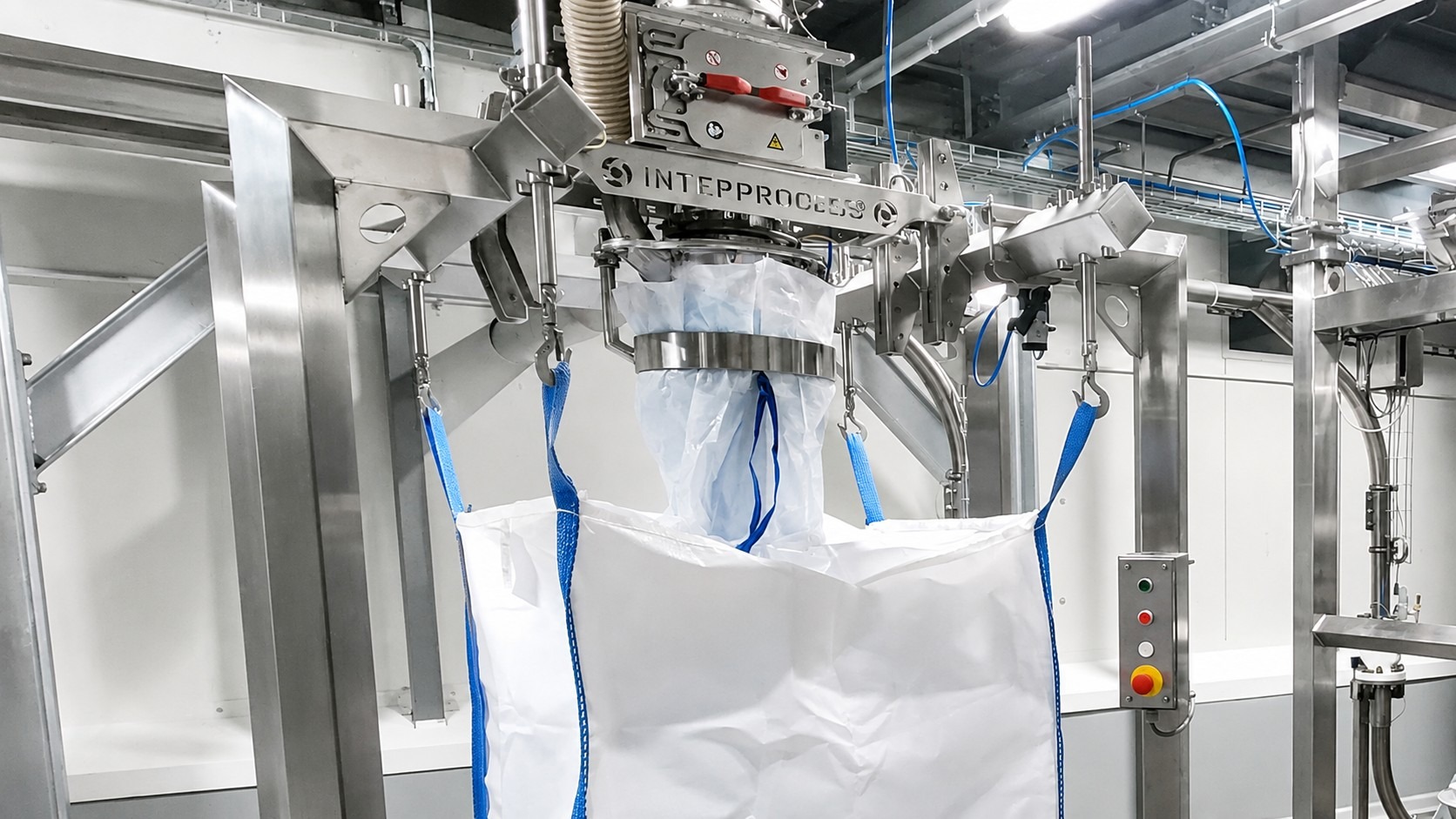
BSA big bag (FIBC) filling stations fill bulk bags efficiently and without dust. We configure every station individually, around the properties of the product, the throughput required, the type of bag and the surrounding conditions. Dust-free operation comes from an inflatable neck seal or a mechanical clamp, while the integrated dust extraction system protects the operator and the surroundings.
The stations work with screw, vibratory and belt feeders, pneumatic conveying, weighing systems and process control and visualisation systems. The build is in powder-coated carbon steel or stainless steel 1.4301 (AISI 304) and 1.4404 (AISI 316L), optionally to food standards (FDA, EHEDG), pharmaceutical standards (GMP) and in an ATEX version. The range is completed by big bag discharge stations.
2000 kgmaximum weight of the bag being filled
do 2500 mmmaximum bag height; width chosen freely
OIML R61optional verification of the weighing system as an automatic weighing instrument
The BSA station family
BSA‑V1 · BSA‑V2
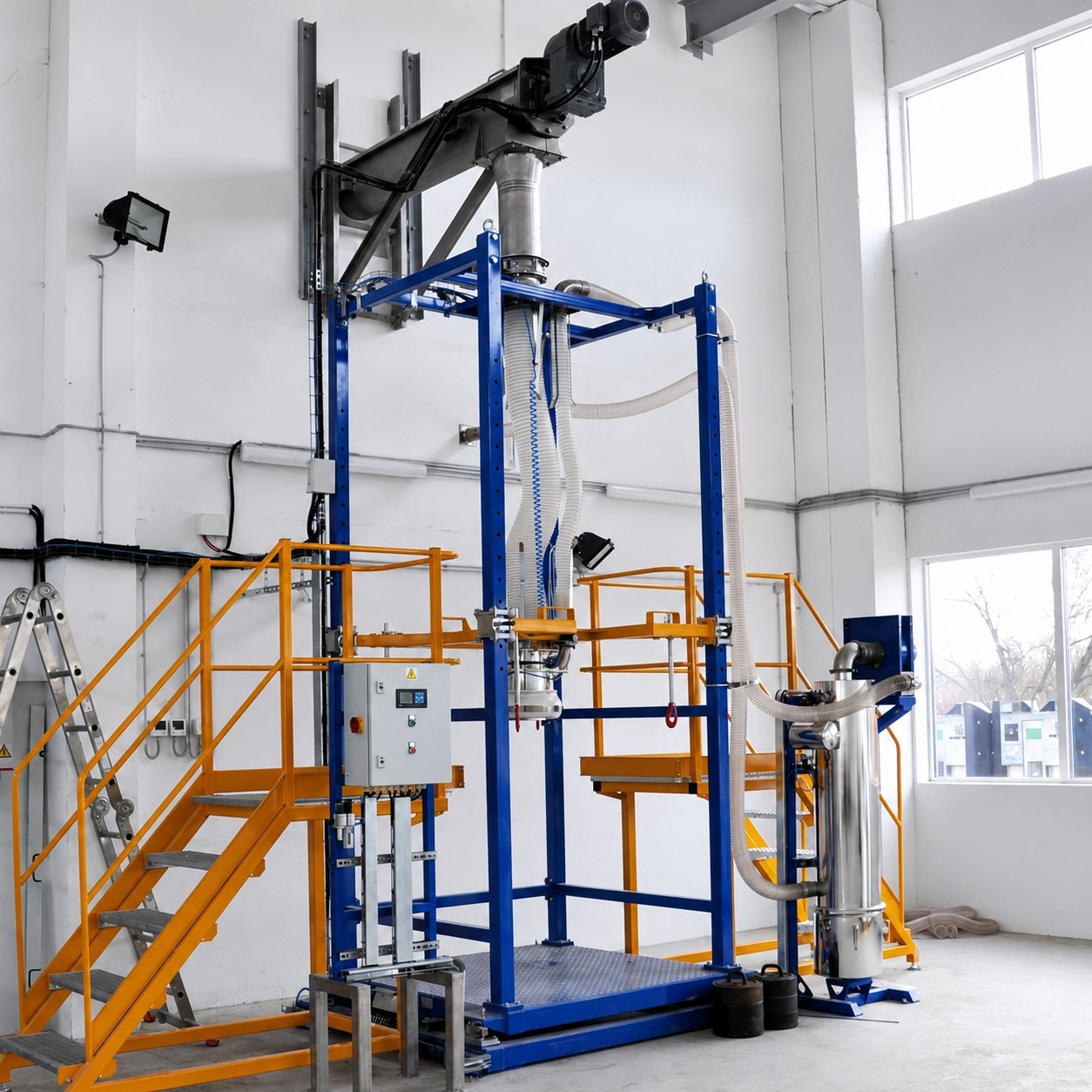
BSA station installations — click to enlarge
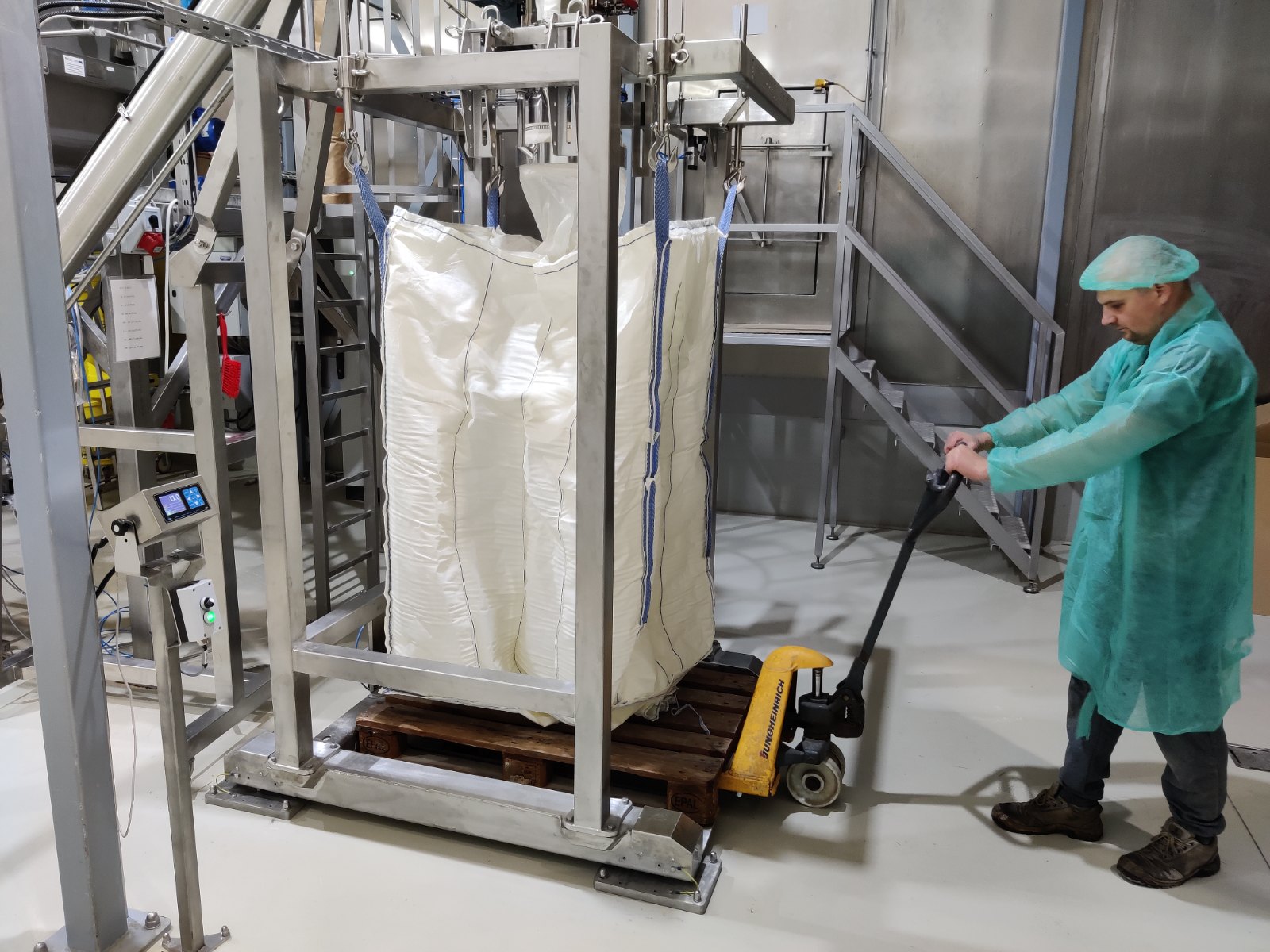
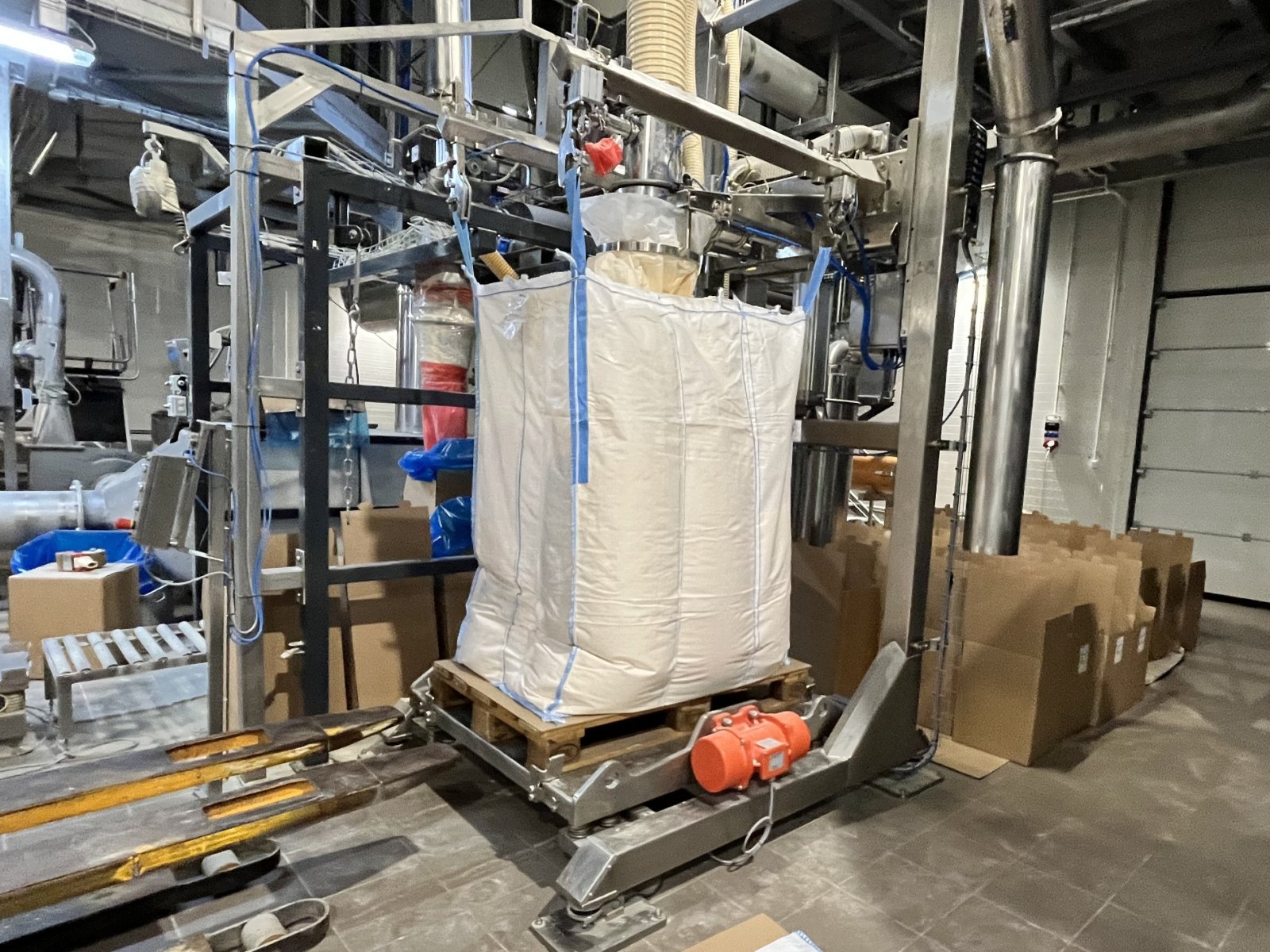
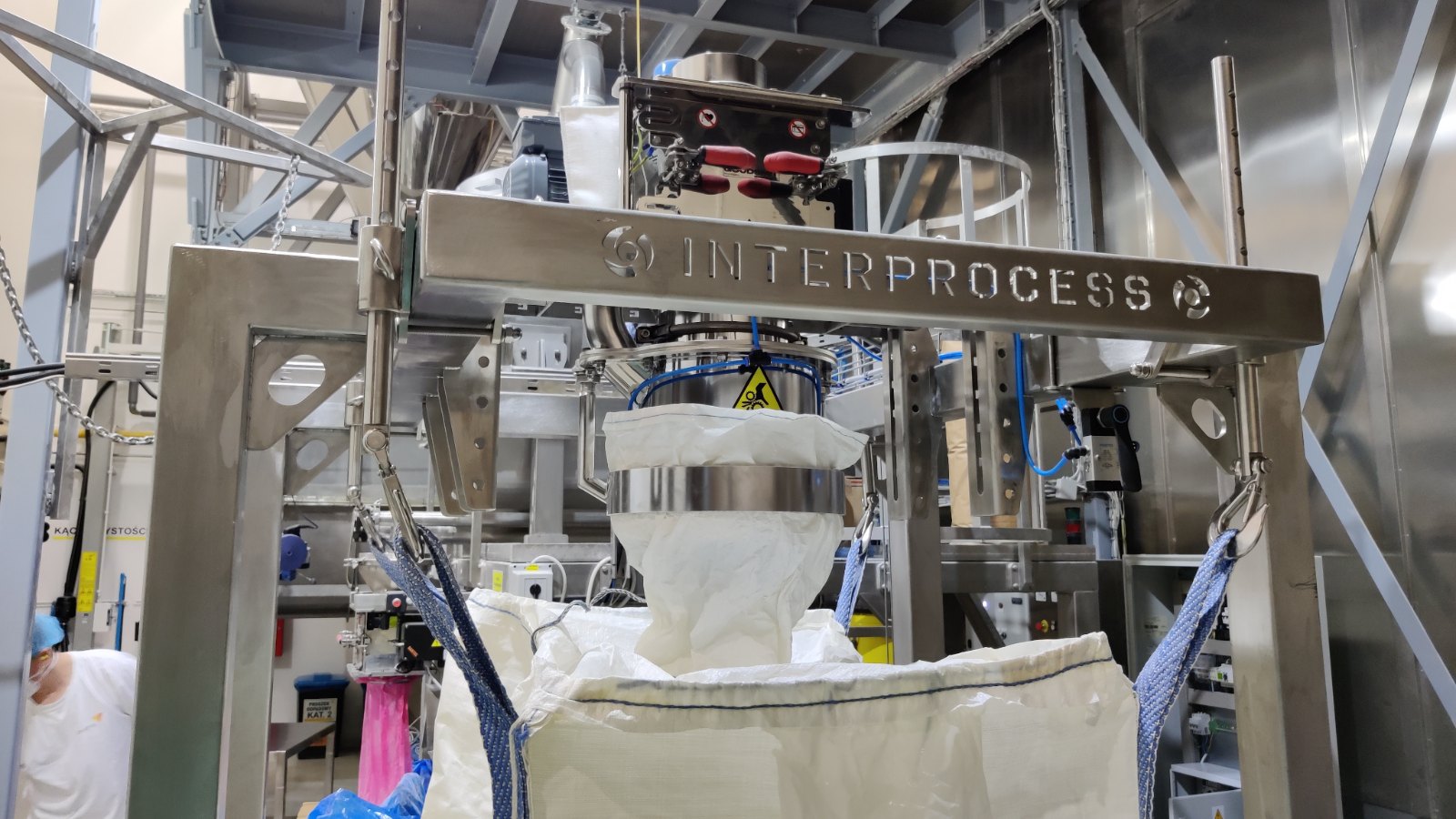
The BSA family comprises two models with identical equipment options, differing in how far bag handling is automated. The empty bag is hung on four holders on the frame, its neck drawn over the fill spout and sealed tight; the material passes straight into the bag, with no contact with the surroundings.
Material can be delivered by any feeder — screw, belt or vibratory. A weighing platform with automatic control shuts off the supply once the set weight is reached, and a vibrating compactor distributes the material evenly so that the full volume of the bag is used.
Key BSA specifications
- Lifting capacity
- up to 2000 kg
- Bag dimensions
- height up to 2500 mm, any width, with the frame matched to the bag
- Station height
- 2000–3000 mm (footprint 1210 × 1445 mm)
- Sealing
- inflatable neck seal or mechanical clamp
- Weighing system
- weighing platform with automatic cut-off, optional OIML R61 verification
- Materials
- powder-coated carbon steel, or stainless 1.4301 (AISI 304) or 1.4404 (AISI 316L)
- Dust extraction
- dust extraction system with a filter, bag pre-inflation with air
- Options
- vibrating compactor, metal detector, sampling, ATEX 21/22 build, FDA, EHEDG
Downloads
BSA-V1 vs BSA-V2
Which model should you choose?
The choice of model depends on how far the process is automated, the throughput required and the way filled bags are taken away. Both models have identical equipment options and differ in how far bag handling is automated.
| Parameter | BSA-V1 standard | BSA-V2 automation |
|---|---|---|
| Type of structure | standard, stationary | advanced, with automation |
| Bag suspension | 4 holders on the frame, manual | 4 holders and automatic quick-release hooks |
| Bag lifting | — | ✓ recommended option; it tensions the bag and optimises filling |
| Roller system | — taken away by fork-lift truck | ✓ works with an automatic roller conveyor |
| Neck sealing | inflatable seal or clamp | inflatable seal or clamp |
| Weighing system | optional (weighing platform, OIML R61) | optional (weighing platform, OIML R61) |
| Vibrating compactor and pre-inflation | optional | optional |
| Max. lifting capacity | 2000 kg | 2000 kg |
| Material and ATEX | carbon steel / AISI 304 / AISI 316L · ATEX optional | carbon steel / AISI 304 / AISI 316L · ATEX optional |
| Typical application | lower-throughput lines, manual handling | automated lines, high throughput |
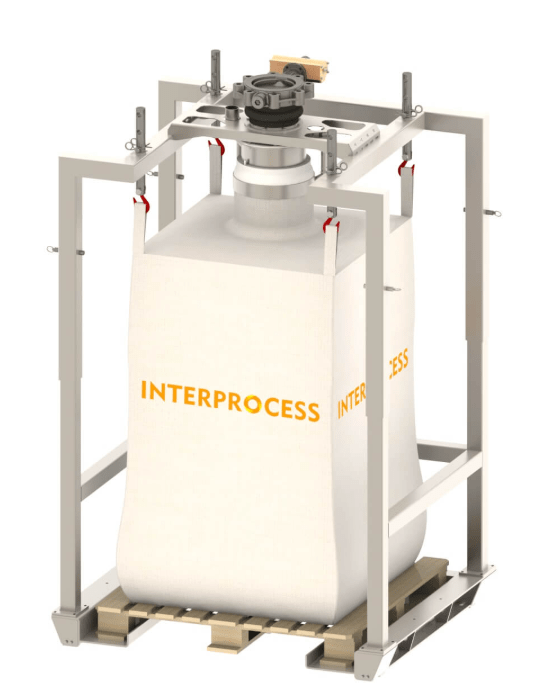
BSA‑V1, the standard filling station
A proven, stationary design for filling bags by hand. The operator hangs the empty bag on the four holders of the frame, draws its neck over the fill spout and starts filling. The tight connection between bag and spout, made by the inflatable seal or the mechanical clamp, keeps the operation free of dust.
The station can be fitted with a weighing platform whose controls shut off the supply once the set weight is reached, with optional OIML R61 verification. Once full, the bag is lifted off the frame and taken away by fork-lift or pallet truck.
Specification: height 2000–3000 mm · footprint 1210 × 1445 mm · bag up to 2500 mm tall · lifting capacity 2000 kg.
BSA‑V2, the station with automatic bag lifting
An advanced design for automated filling lines. The BSA-V2 works with an automatic roller system: the filled bag travels on its pallet to the palletising area or the store, with no fork-lift truck involved.
Automatically releasing slings — quick-release hooks — shorten the cycle, while the recommended bag lifting arrangement tensions the bag during the first phase of filling, helps the material spread evenly and makes better use of the volume of the bag.
Key features: automatic hooks · roller conveyor · bag lifting · integration with the weighing system, the compactor and the line controls.

Modular construction
Optional equipment and integration
Sealing and dust extraction
A twin-channel filling head: the inner channel delivers the product, the outer one carries dusty air away to the filter. An inflatable neck seal or a mechanical clamp, and bag pre-inflation, for bags with a liner as well.
Weighing and feeding
A weighing platform with two-stage feeding, coarse and fine. OIML R61 verification as an automatic weighing instrument, a vibrating compactor to de-aerate and densify the product, and automatic sampling.
Safety and inspection
A rare-earth magnetic separator or a metal detector, an ATEX build (zone 21/22), materials compliant with FDA and EHEDG , and integration with the line’s control and visualisation system .
The working cycle
How is a big bag filled?
-
STEP 01
Preparing the bag
The empty bag is hung on the holders of the frame. Its neck is drawn over the fill spout and sealed with the inflatable seal or the clamp. Optionally the bag is pre-inflated with air.
-
STEP 02
Filling and weighing
The feeder delivers material in a two-stage cycle: fast coarse feeding, then precise fine feeding as the set weight approaches. The controls shut off the supply, and the vibrating compactor de-aerates and densifies the product.
-
STEP 03
Taking the bag away
The neck seal is released and the bag lifted off the frame, by hand on the BSA-V1 or by automatic quick-release hooks on the BSA-V2, then taken away by truck or by roller conveyor to the palletising area. A densified, evenly filled bag forms a stable load that is safe to store and to transport.
FAQ
Frequently asked questions
How is dust contained during filling?
The neck of the big bag is drawn over the station’s fill spout and sealed tight with a pneumatic inflatable seal or a mechanical clamp. The material therefore passes straight into the bag, with no contact with the surroundings. The station is also fitted with a dust extraction system and filter, which captures the dust raised during filling.
Which model should I choose, the BSA-V1 or the BSA-V2?
The BSA-V1 is a stationary design operated by hand, and suits lower-throughput lines where the bag is taken away by fork-lift truck. The BSA-V2 is built for automated lines: it has automatic quick-release hooks, works with a roller conveyor, and we offer the bag lifting arrangement as a recommended option. Both models have identical equipment options — weighing, compactor, seal, ATEX. Our engineers will help you choose once they have looked at the process.
Can the station be adapted to unusual bags?
Yes, every station is designed individually. The modular construction allows the height, the width of the frame, the type of holders, the diameter of the fill spout and the sealing system to be matched to one particular type of bag. We handle bags up to 2500 mm tall and up to 2000 kg; bag width is not limited, and we match the frame to its dimensions. For unusual bags, please fill in the technical questionnaire.
Can the station work as an automatic weighing instrument?
Yes, a BSA station can be fitted with a weighing platform that shuts off the supply automatically once the set weight is reached. On request the weighing system is verified as an automatic weighing instrument to OIML R61, which is required where material is sold by weight. We match the accuracy and the parameters of the system to the product.
Can the station work in an explosive atmosphere?
Yes, both BSA models are available in an ATEX build for work in zones with a risk of dust explosion (zone 21/22). The build covers the appropriate seals, antistatic earthing, certified electrical components and documentation compliant with Directive 2014/34/EU. On request we use materials compliant with FDA requirements and EHEDG guidelines.
Why InterProcess
Why choose our solutions?
Dust-free filling
Inflatable seal, dust extraction system, bag pre-inflation.
Modular construction
Weighing, compactor, sampling, hooks, bag lifting, roller system.
Individual design
Every station is matched to the type of bag and the nature of the process.
Experience across many industries
Food, chemicals, pharmaceuticals and construction.
Safety and hygiene
ATEX, FDA, EHEDG and GMP builds.
Technical support and service
A fast response, spare parts availability, 24/7 cover.
Need a station for filling big bags?
Get in touch and we will design a station matched to your product, your type of bag and the throughput you need. Fill in the technical questionnaire, or arrange a call with an engineer.