InterProcess Sp. z o.o. | Solutions for industry

What vibratory feeders are
Gentle feeding with no moving parts
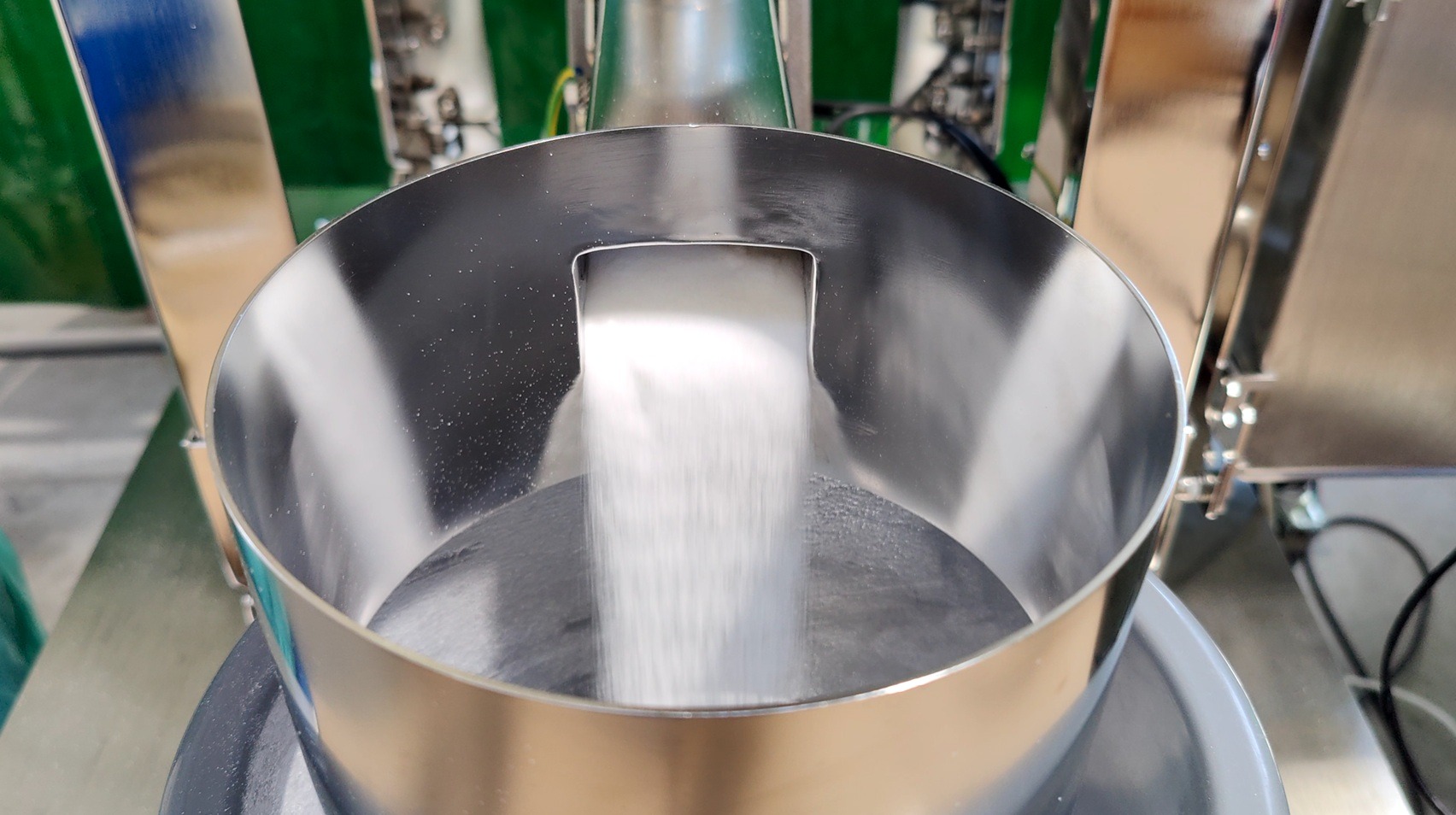
Gravimetric DVC vibratory feeders, also called vibrating feeders, work on the loss-in-weight principle and deliver free flowing bulk solids — granules, flakes and pellets — quickly and accurately. Material travels along an electromagnetically driven vibrating trough, with no screw and no agitator. Friable material is neither crushed nor abraded, and stopping the vibration cuts off the flow at once, with no carry-over into the equipment below. The DVC family comes in three sizes — DVC45, DVC60 and DVC200 — covering throughputs from 0.1 to about 5000 kg/h.


DVC45 vibratory feeder
Compact precision
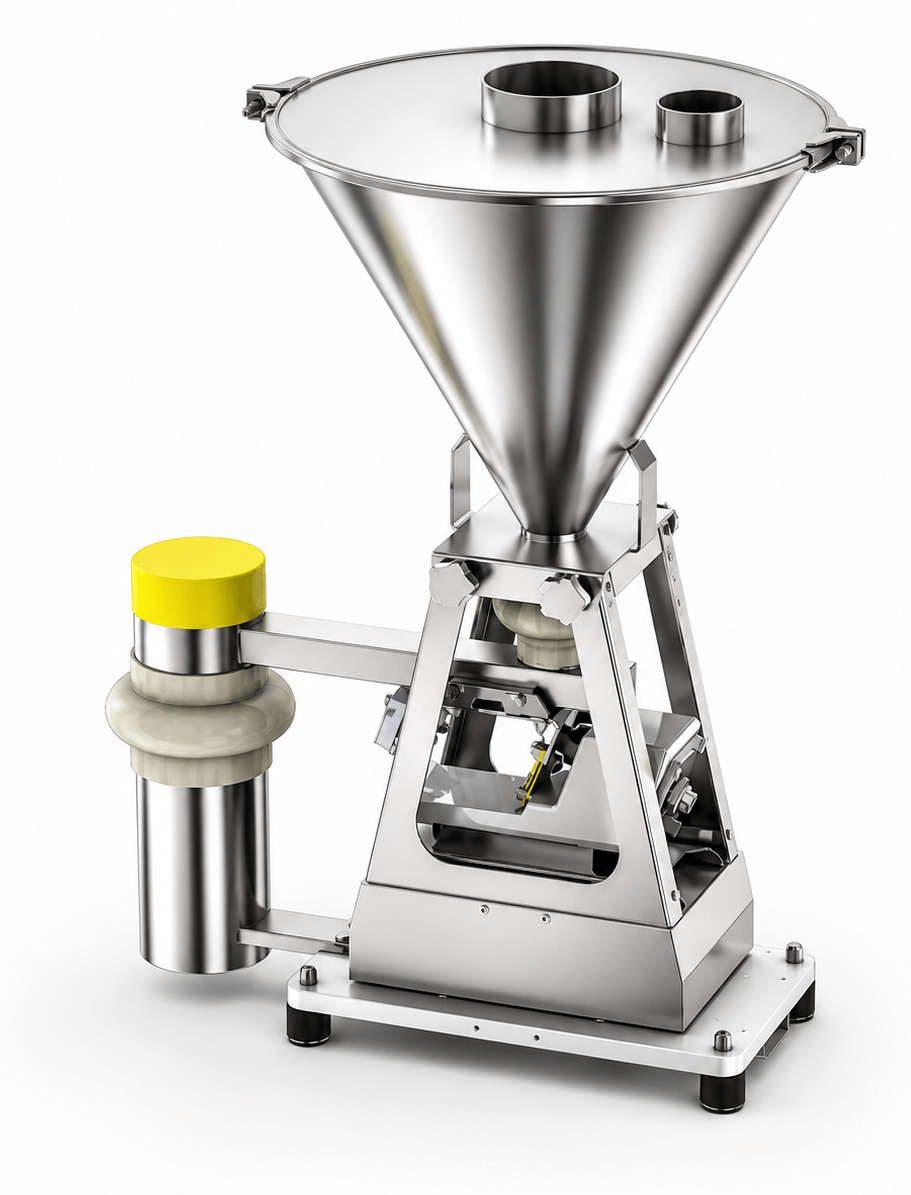
The DVC45 is the smallest model in the family, intended for low rates and the feeding of micro-ingredients. The hopper is conical, which assures uniform emptying, and the electromagnetic drive with feedback allows operation close to the resonant frequency. The modular construction makes dismantling for cleaning easy; the lid carries spigots for filling and venting.
Key DVC45 specifications
- Accuracy±0.5% of setpoint
- Volumetric throughputup to 450 l/h
- Hopper (conical)15 or 30 l
- Measuring system1 load cell, class C3, IP66 (IP68 optional)
- Driveelectromagnetic, 230 V AC, 50 Hz
- Total weight28 kg (15 l) / 32 kg (30 l)
- Operating temperature0–50°C
- Materialssteel 1.4301 (AISI 304) or 1.4404 (AISI 316L)
Downloads
DVC60 vibratory feeder
The versatile standard
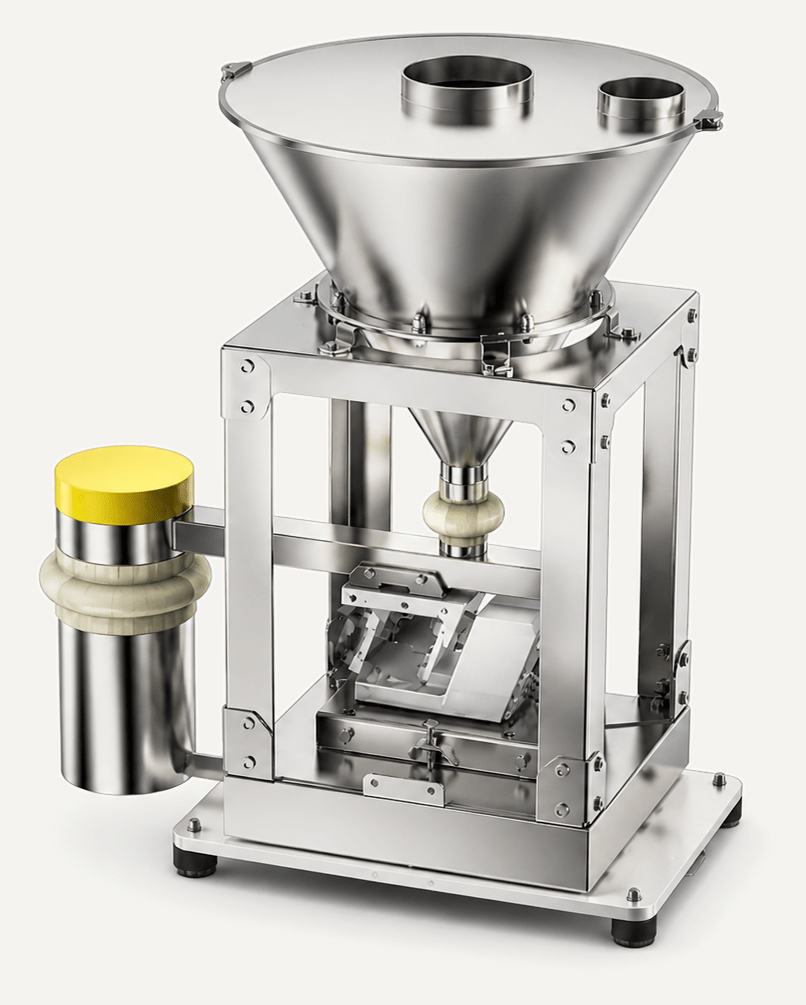
The DVC60 is the versatile model for continuous and batch feeding on production lines. A larger hopper, of 45 or 90 l, and a more powerful electromagnetic drive take the throughput to 1000 l/h while holding the same ±0.5% accuracy. Every part in contact with the product is stainless steel, and the optional hygienic build — continuous welds, surfaces ground to Ra<0.8 μm — meets the requirements of the food and pharmaceutical industries.
Key DVC60 specifications
- Accuracy±0.5% of setpoint
- Volumetric throughputup to 1000 l/h
- Hopper (conical)45 or 90 l
- Measuring system1 load cell, class C3, IP66 (IP68 optional)
- Driveelectromagnetic, 230 V AC, 50 Hz
- Total weight87 kg (45 l) / 97 kg (90 l)
- Operating temperature0–50°C
- Materialssteel 1.4301 (AISI 304) or 1.4404 (AISI 316L)
Downloads
DVC200 vibratory feeder
Industrial throughput
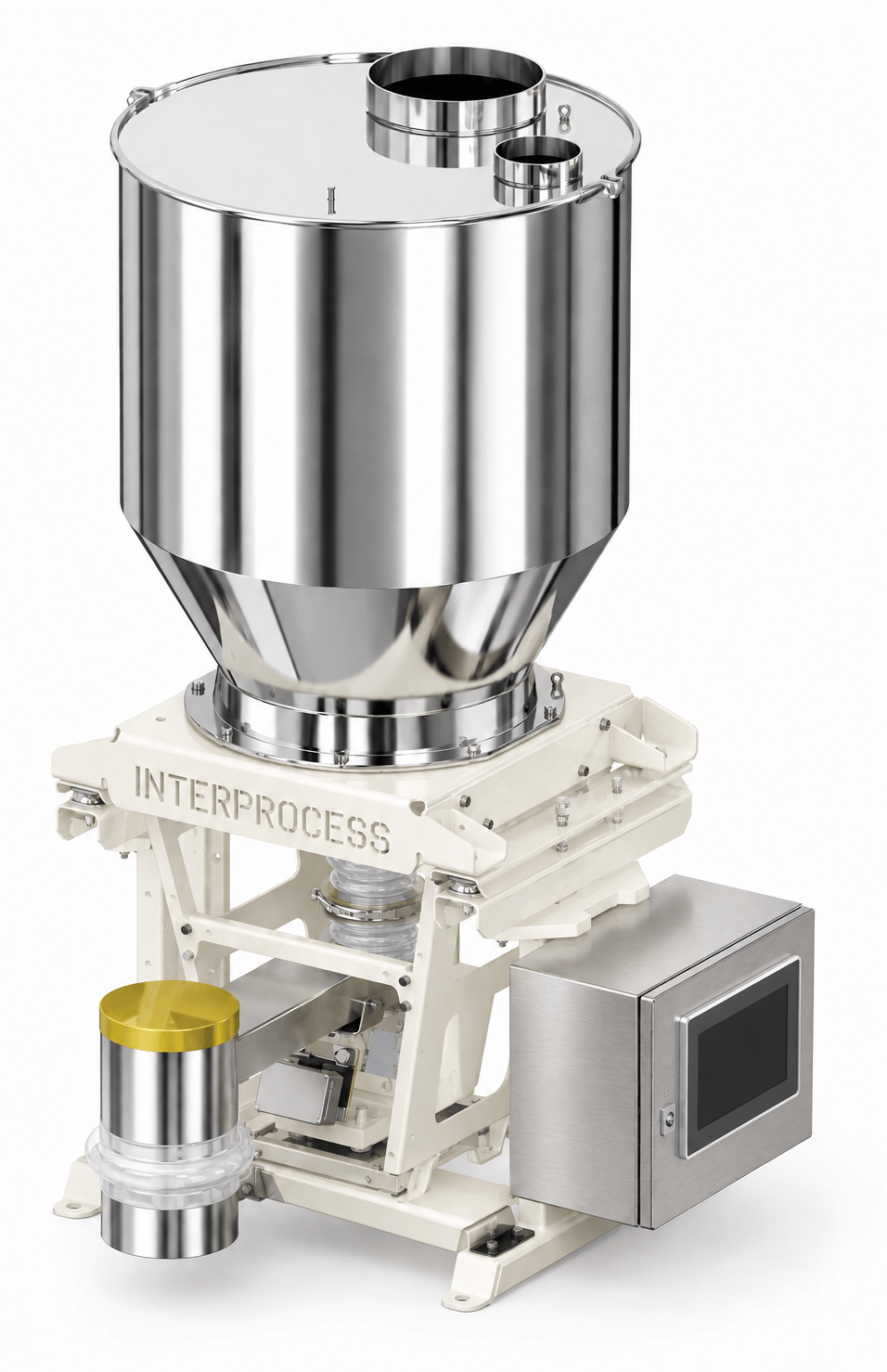
The DVC200 extends the DVC family into industrial throughputs — up to 5000 l/h. The conical hopper enforces mass flow and uniform emptying, and feeding runs in a loss-in-weight loop with measurement on two OIML C3 load cells (stainless steel, IP68). The signal from the weighing system corrects the vibration amplitude continuously, compensating for changes in bulk density and flowability — the feed characteristic stays linear and repeatable across the whole 1:50 turndown range, with minimal pulsation of the discharge.
Key DVC200 specifications
- Accuracy<0.5% of setpoint
- Volumetric throughputup to 5000 l/h
- Turndown ratio1:50
- Hopper (conical)100, 200 or 300 l
- Measuring system2 OIML C3 load cells, stainless steel, IP68
- Driveelectromagnetic, with amplitude feedback
- Operating / material temperature0–45°C / 0–60°C
- Materialssteel 1.4301 (AISI 304) or 1.4404 (AISI 316L)
Downloads
DVC45 vs DVC60 vs DVC200
Which model should you choose?
In short: the DVC45 up to 450 l/h, the DVC60 up to 1000 l/h, the DVC200 up to 5000 l/h. We match the size of the feeder to the rate required, the batch size and the space available. All three models share the same operating principle and the same control system.
| Parameter | DVC45 compact | DVC60 versatile | DVC200 high throughputs |
|---|---|---|---|
| Volumetric throughput | up to 450 l/h | up to 1000 l/h | up to 5000 l/h |
| Hopper capacity | 15 / 30 l | 45 / 90 l | 100 / 200 / 300 l |
| Accuracy (continuous) | ±0,5% | ±0,5% | <0.5% |
| Measuring system | 1 C3 load cell, IP66 | 1 C3 load cell, IP66 | 2 OIML C3 load cells, IP68 |
| Total weight | 28–32 kg | 87–97 kg | per hopper configuration |
| Operating temperature | 0–50°C | 0–50°C | 0–45°C (material up to 60°C) |
| Typical application | Micro-ingredients, laboratories, additives | Production lines, continuous and batch feeding | High rates, main recipe ingredients |
| Shared features | Electromagnetic drive with feedback · AISI 304/316L steel · modular construction · options: hygienic build, Ex (ATEX), cartridge filter, grid and feed hopper · communication over EtherNet/IP, Modbus TCP/IP, PROFIBUS, PROFINET | ||
Loss-in-weight
Principle of operation — feeding in a loss-in-weight loop
The whole feeding assembly — the conical hopper with its material and the vibrating trough with its drive — rests on load cells and is joined to the filling point and the discharge pipework by flexible connections, which removes the influence of external forces on the measurement. The system measures the loss in weight over time and derives the actual mass flow from it. A PID controller compares that with the setpoint and corrects the vibration amplitude of the electromagnetic drive — the feed characteristic stays linear across the whole throughput range.
When the level in the hopper falls below the minimum, refilling starts automatically without interrupting the feed — the feeder changes briefly to volumetric mode at the last recorded amplitude, and returns to full gravimetric mode once the hopper is full. Switching off the vibration stops the flow of material at once, which gives a fast, clean cut-off of the batch in batch feeding.
Choosing the technology
When a vibratory feeder rather than a screw feeder?
We choose a vibratory feeder where the material has to travel without touching rotating parts — with friable products such as flakes, fibres and pellets, and with strongly abrasive ones such as glass-fibre filled granules. The DSL G screw feeder copes better with fine, cohesive powders and offers a wider throughput range. The choice is decided above all by the physical properties of the material — where there is any doubt we run feeding trials on a sample of your product.
| Criterion | Vibratory (DVC) | Screw (DSL G) |
|---|---|---|
| Feeding principle | Electromagnetic drive — vibration | Rotating screw / spiral |
| Moving parts | None — gentle transport, no wear | Screw plus agitator |
| Best suited to | Friable and abrasive materials, granules, flakes, fibres | Powders, fine and coarse, and cohesive materials |
| Throughput range | 0.1 – about 5000 kg/h | 0.5 – 30,000 kg/h |
| Turndown ratio | up to 1:100 | 1:10 |
| Cut-off of flow | Immediate — stop the vibration, stop the material | Residual discharge from the screw is possible |
| Accuracy (LIW, continuous) | <±0.5% of setpoint | <±0.5% of setpoint |
| Cleaning | Modular construction, optional tool-free dismantling | Screw and agitator have to be removed |
Industries and applications
Applications in key industries


FAQ
Frequently asked questions
Why InterProcess
Why choose our solutions?
In-house manufacture
We design and build DVC feeders in our own works.
Feeding trials
We will test your material on a real feeder before you buy.
A complete feeder range
Vibratory, gravimetric and volumetric screw, and belt weighfeeders.
Multi-ingredient systems
We design complete recipe feeding lines.
Safety and hygiene
Systems compliant with ATEX, HACCP and GMP.
Technical support and service
With a fast response, 24/7 if required.