- InterProcess Sp. z o.o.

Belt Weighers (Conveyor Scales)
Belt weighers (also referred to as conveyor belt scales or in-motion weighers) are used for the continuous measurement of bulk material flow on a conveyor belt. They enable you to monitor raw material consumption, supervise blend ratios, track loading and unloading operations, and control the process — all without interrupting material transport.
The InterProcess product range includes three models of belt weighers (conveyor scales), each designed for different load ranges and accuracy requirements. The flagship WPC1 combines the highest precision with a robust construction, whilst the WPC2 extends the weighing zone with additional modules, achieving an accuracy of better than ±0.25%. The compact WPL is the most cost-effective solution, ideal where simplicity and limited installation space are the primary considerations. We manufacture proven, ready-to-install designs for customers’ existing conveyors, and for non-standard layouts we supply units engineered specifically to suit the existing installation conditions.
Operating Principle of a Belt Weigher
A typical conveyor belt weigher consists of a weighing bridge (load-bearing frame) mounted on strain-gauge load cells, an electronic measuring device (integrator/totaliser), and a belt speed sensor. The load cells measure the load on the belt within the weighing zone, generating a voltage signal proportional to the material mass. Simultaneously, a speed sensor — most commonly fitted at the tail drum — provides information on the current belt speed in the form of pulses.
Based on these two signals, the integrator calculates the mass flow rate (kg/s or t/h) and the accumulated totaliser reading (kg, t). Furthermore, modern integrators support communication with supervisory systems (PLC, SCADA) via industrial protocols such as Modbus, Profibus, Profinet, and EtherNet/IP. As a result, the belt weigher becomes an integral part of the plant’s process automation.
Belt Weigher WPC1 – Highest Precision
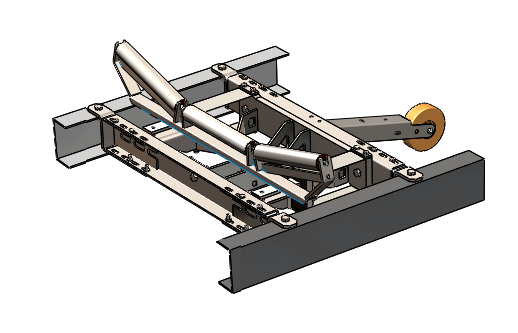
The WPC1 is our most frequently recommended belt weigher. Its parallelogram frame constructed from flat springs — with no levers or pivots — was developed in response to the dynamic demands of weighing systems operating under very high loads. The use of a single stainless-steel strain-gauge load cell with an IP68/IP69K ingress protection rating minimises the risk of failure. In addition, telescopic side arms ensure the weigher is precisely matched to the customer’s conveyor.
Key specifications of the WPC1:
- Accuracy: measurement error below ±0.5%
- Belt width: 500 to 2,000 mm
- Maximum throughput: up to 12,000 t/h
- Load cell: stainless steel, IP68
- Construction: parallelogram frame with flat springs, no pivots
- Adjustment: idler level adjustment available
Downloads:
Belt Weigher WPC2 – Highest Accuracy
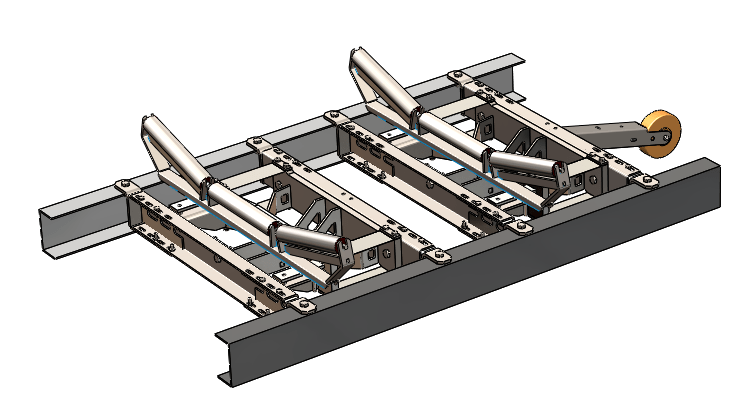
The WPC2 is in effect two or more WPC1 weighers arranged in series on a single conveyor. Extending the weighing zone allows for more accurate averaging of the belt load, resulting in even greater measurement precision. All the advantages of the WPC1 design — parallelogram frame, IP68 load cell, no pivots — are fully retained in this configuration.
Key specifications of the WPC2:
- Accuracy: measurement error below ±0.25%
- Configuration: two or more WPC1 frames in series
- Belt width: 500 to 2,000 mm
- Maximum throughput: up to 12,000 t/h
- Load cells: stainless steel, IP68
Downloads:
Belt Weigher WPL – Compact Design and Competitive Price
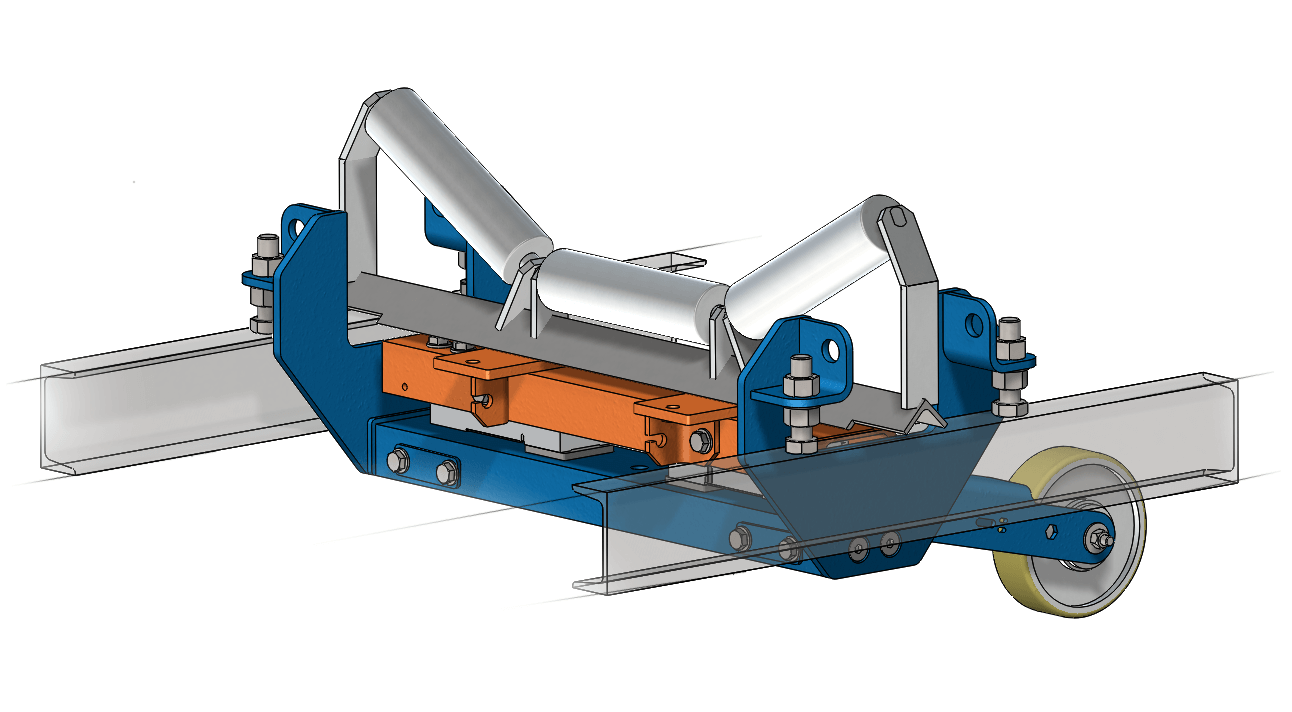
The WPL is the smallest and most competitively priced belt weigher in our range. Its compact dimensions make it ideally suited to applications where installation space is restricted — for example, on mobile crushers or short conveyors. Despite its small footprint, the construction remains extremely rigid even under high loads, and the enclosed strain-gauge load cells are protected against mechanical damage.
Key specifications of the WPL:
- Accuracy: ±0.5–2%
- Belt width: up to 1,200 mm
- Maximum throughput: up to 4,000 t/h
- Load cells: two aluminium strain-gauge load cells, IP67
- Adjustment: weigher level adjustment available
Downloads:
Belt Weigher Model Comparison
| Parameter | WPC1 | WPC2 | WPL |
|---|---|---|---|
| Accuracy | <±0.5% | <±0.25% | ±0.5–2% |
| Belt width | 500–2,000 mm | 500–2,000 mm | up to 1,200 mm |
| Max. throughput | 12,000 t/h | 12,000 t/h | 4,000 t/h |
| Strain-gauge load cells | 1× stainless steel, IP68 | 2× stainless steel, IP68 | 2× aluminium, IP67 |
| Frame construction | Parallelogram (flat springs) | Multi-point (WPC1 in series) | Compact, rigid |
| Level adjustment | Idlers | Idlers | Weigher |
| Typical application | General purpose – most applications | Highest precision, trade measurement | Restricted space, mobile crushers |
Measuring Electronics and Control Systems
Every InterProcess belt weigher operates in conjunction with our measuring electronics, which offer considerably more than basic flow measurement. Depending on application requirements, the system can be equipped with flow control functions, batch dosing mode, PLC and SCADA communication (Modbus RTU/TCP, Profibus DP, EtherNet/IP), and production data logging. An HMI interface allows the operator to intuitively monitor flow rates, adjust parameters, and review measurement history.
For each of our weighers, we can issue a calibration certificate with a calculated measurement uncertainty. Our engineering team also provides on-site installation, commissioning, and calibration — using either the static method (with test weights) or the material method (by comparison with a reference weigher).
If you require more precise material dosing with active flow regulation rather than measurement alone, please refer to our range of belt feeders DTU and DTC, which combine the weighing function with a closed-loop belt speed control system.
Industrial Applications of Belt Weighers
Belt weighers (conveyor scales, in-motion weighers) are used across virtually every industry in which bulk materials are transported on conveyor belts. The most common applications include mining and extraction (ore, coal, and aggregate flow monitoring), cement and lime production (raw material and finished product monitoring), energy generation (coal and biomass measurement on the feed line to the boiler), recycling (waste weighing on sorting lines), and the food and chemical industries (raw material balancing and consumption control). In each of these cases, continuous mass flow measurement enables process optimisation, reduction of material losses, and compliance with trade measurement requirements.
Frequently Asked Questions (FAQ)
The choice of model depends on the required accuracy, belt width, and installation conditions. The WPC1 is a general-purpose model suitable for the majority of applications, achieving an accuracy of better than ±0.5%. If higher precision is required (below ±0.25%) — for instance for trade measurement purposes — the WPC2 with its extended weighing zone will be the better option. The WPL is the ideal solution where installation space is restricted and an indicative accuracy of ±0.5–2% is sufficient.
Belt weigher calibration can be carried out in two ways. The static method involves placing test weights of known mass on the weigher with the belt running empty — it is quick and straightforward to perform. The material method involves comparing the belt weigher reading against a reference weigher (e.g. a weighbridge) for the same batch of material. This is the most accurate method and is recommended during commissioning and periodic verification checks. In addition, zero calibration — which involves checking the reading with an empty, running belt — should be performed daily or at least once a week.
A belt weigher measures mass flow on a customer’s existing conveyor — its primary function is measurement and totalisation. A belt feeder, on the other hand, is a complete self-contained unit with an integrated conveyor, its own drive, and a closed-loop PID control system that actively regulates belt speed in order to maintain the set mass flow rate. If you require measurement only — choose a belt weigher. If you require precise dosing with automatic regulation — a belt feeder is the appropriate solution.
Belt weigher accuracy is influenced by numerous factors. The most significant are the quality and condition of the conveyor belt (uniform thickness, cleanliness), the structural stability of the conveyor (absence of vibration, correct levelling), the uniformity of material feed, and regular zero and span calibration. The position of the weigher on the conveyor is also important — it should be located in a zone free from the influence of the drive and take-up unit, with adequate straight sections both upstream and downstream of the weighing zone.
Yes — our belt weighers are designed for installation on existing conveyor belts. The telescopic side arms of the WPC1 and WPC2 models ensure compatibility with varying idler spacings. For non-standard configurations — such as conveyors with an unusual belt width or atypical profile — we design the weigher individually to suit the customer’s installation conditions. Our engineering team provides on-site installation, commissioning, and calibration.
Do You Need a Belt Weigher?
Get in touch with us — simply send us the details of your conveyor, the material being transported, and the required accuracy, and we will select the appropriate model and prepare a complete quotation.
Why Choose Our Solutions?
In-house manufacturing – our belt weighers are designed and manufactured in our own production facility
Tailored approach – we adapt the weigher to the customer’s existing conveyor
Turnkey delivery – from design through to installation, calibration, and ongoing service
Calibration certificate – issued for every weigher, with calculated measurement uncertainty
Multi-industry experience – mining, cement, energy, recycling, food processing
Technical support and service – with rapid response, including 24/7 availability