InterProcess Sp. z o.o. | Solutions for industry


Piotr Przedpełski
■ Manufacturer – Bulk Material Feeders – Big-Bag Stations – Pneumatic Conveying Systems ■ I optimize the handling of bulk materials & help automate weighing and feeding processes ▶ CEO and founder of InterProcess
October 20, 2026
Introduction — where does this idea come from?
I regularly encounter situations where a customer considers fitting a standard belt scale to an existing conveyor — rather than using a dedicated belt weighfeeder. The logic seems straightforward: “I already have a conveyor, I’ll add a scale and start dosing.” Some want to place the scale on a collecting conveyor and regulate the material stream using devices upstream. It is an understandable approach — it appears to save budget and makes use of existing infrastructure or available production capacity.
The problem is that a belt scale and a belt weighfeeder are fundamentally different devices in terms of design philosophy. In continuous feeding applications, this difference has real consequences — for accuracy, process stability and operating costs.
In this article, I explain how these two solutions differ and why, in feeding applications — particularly continuous ones — a dedicated belt weighfeeder is an investment that pays for itself.
A belt scale measures flow. A belt weighfeeder controls it.
This is the fundamental distinction to start with.
A belt scale is a measuring device installed on a transport conveyor. Its role is to measure the mass flow rate of material passing through the weighing zone — it tells you how much material has passed and at what instantaneous rate. However, it does not influence that flow, or does so only to a limited extent. The conveyor on which it is mounted was designed for transport — not for precise feeding.
A belt weighfeeder is an integrated feeding system, designed from the ground up for a single purpose: delivering bulk material at a controlled, repeatable rate. The weighfeeder not only weighs material on the belt but actively regulates belt speed via a PID control loop, maintaining the desired mass flow rate in real time. It is therefore both a measuring and an actuating device simultaneously.
Accuracy — and what affects it
A typical belt scale on a standard transport conveyor achieves a measurement accuracy of around 1–2%, but not necessarily a feeding accuracy. A dedicated belt weighfeeder achieves better than ±0.5% of the set point, and in selected applications even below ±0.25%. Crucially, this is not merely measurement accuracy — it is actual feeding accuracy measured against the set point. Feeding accuracy means that over a given period, the system delivers material within a defined error band, which demands high-quality control performance.
Where does this difference come from? It is not down to the quality of the strain gauge load cells — these may well be identical. It stems from how the entire device has been engineered: the mechanics, the drive, the belt tensioning system, the cleaning arrangement, the method of feeding material onto the belt, and the control algorithm. The individual factors are discussed below.
Compactness and dynamics
A belt weighfeeder achieves full measuring accuracy with pulley centres as short as 1–1.5 m (depending on the model). This is a deliberate design decision — a short belt minimises the influence of belt irregularities, vibration, temperature changes and internal stresses on measurement accuracy.
A belt scale requires a considerably longer conveyor to provide an adequate weighing zone with multiple approach, scale and retreat idlers. A long belt not only takes up more space in the plant but also — critically — introduces greater inertia during speed changes.
In continuous feeding, rapid response to flow deviations is the foundation of process stability. A compact weighfeeder responds immediately; a long conveyor with a belt scale responds with a delay that is difficult to compensate for in PID control.
Gravity belt tensioner
This is one of the most important structural elements of a belt weighfeeder — and at the same time, an element that a typical transport conveyor most often lacks in an appropriate form.
On a long transport conveyor, belt tension varies with load, ambient temperature and belt wear. Every change in tension causes zero drift on the scale — and consequently the need for frequent recalibration. With temperature fluctuations throughout the day, readings can “float” — different in the morning than at midday.
In a belt weighfeeder, a gravity (counterweight) tensioner maintains a constant, repeatable tensioning force regardless of conditions. It is no coincidence that every reputable belt weighfeeder manufacturer in the world uses this element as a standard design feature — because they know that without it, stable long-term measurement is simply not achievable.
Material build-up
Adhesion of material to the belt (both carrying and return sides), carrying idlers and the weighing zone is the main cause of slow, progressive measurement drift in belt scales. Material accumulating on scale components adds apparent mass to the reading — and the operator often does not notice this effect, as it develops gradually.
A belt weighfeeder has built-in scrapers — internal (under the return belt) and external (at the front pulley) — as standard components. These keep the belt and the weighing zone clean. On a typical transport conveyor, scrapers are an option — often unavailable or omitted to save costs.
Dynamic discrete tare — belt influence compensation
A conveyor belt is not perfectly uniform — it has a splice, local thickness variations and changes in stiffness along its length. Each such irregularity causes a cyclic measurement error that repeats with every belt revolution.
Belt weighfeeders are equipped with a belt influence compensation function. The system measures the mass of the empty belt point by point along its entire circumference and creates a correction profile. During operation, this profile is automatically subtracted from the live measurement — eliminating the cyclic error arising from belt non-uniformity.
On a standard conveyor with a typical belt scale, this function is usually not available. This is due both to limitations of the scale electronics, the belt not being adapted for this operation, and the fact that the long belt of a transport conveyor (with a considerably larger circumference) makes such compensation technically more challenging.
Belt slip and misalignment detection
A belt that slips on the drive pulley or tracks to one side generates measurement errors — and on a typical belt scale, these errors remain invisible because the system simply does not detect them. The operator does not know that the measurement is faulty until a manual check is carried out.
In a belt weighfeeder, the belt has a built-in marker read by a dedicated sensor. This enables continuous monitoring of both slip (the difference between pulley speed and actual belt travel) and misalignment (lateral belt displacement). If tolerances are exceeded, the system raises an alarm or stops the device.
This is not a “nice-to-have option” — it is a prerequisite for long-term measurement reliability. Without slip detection, the speed error feeds directly into the mass flow calculation (flow = belt load × speed). Even 1% slip means 1% error on flow — and it is a systematic error that accumulates unnoticed.
Turn-down ratio
Belt weighfeeders offer a wide flow regulation range — typically 1:10 — whilst maintaining declared accuracy across the entire range. This means the same weighfeeder can operate at 40 t/h and 4 t/h without loss of measurement quality.
On a standard conveyor with a belt scale and a regulated device feeding material onto it, the regulation range is considerably narrower. At low belt loading, the signal from the strain gauge load cells approaches the noise floor, and the influence of the belt’s own mass on the measurement becomes dominant. The result: the scale “loses” material at low throughputs.
This is particularly important in plants where line capacity changes during a shift or varies with product type — a belt weighfeeder maintains accuracy across a wide range; a conveyor with a belt scale does not.
Dust-tight design
A belt weighfeeder can be fully enclosed — like our DTU in its closed version, in a dust-tight stainless steel housing — or fitted with dust covers connected to an aspiration (dust extraction) system — as with the DTC. The result: no dust emission to the surroundings, compliance with health and safety and ATEX requirements, and protection of the weighing sensors from contamination.
A standard conveyor with a belt scale is typically an open construction. Retrofitting a sealed enclosure to a long conveyor is costly, structurally problematic, and often amounts to an “improvisation” that hinders servicing and access to the scale.
Pre-feed device selection — a weighfeeder is a system, not just a belt
This is a point often overlooked in the “weighfeeder vs. belt scale” discussion — yet it is absolutely critical to continuous feeding accuracy.
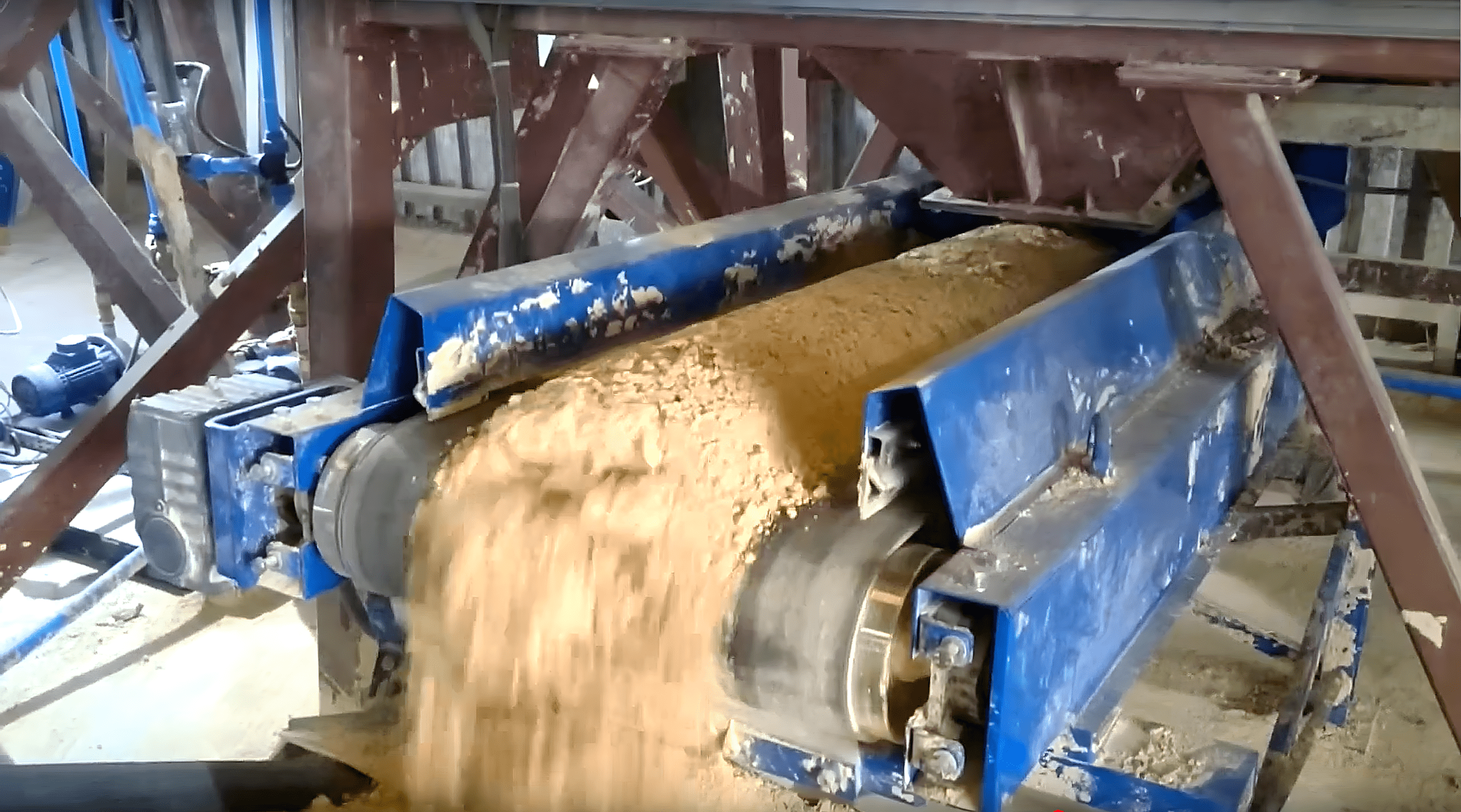
A belt weighfeeder is not a conveyor with a scale. It is a complete feeding system in which the feed hopper or pre-feeder is an integral part of the solution, selected to match the specific flow properties of the material being dosed.
Depending on whether the material is free-flowing, bridging, dusty, aerating or sticky, the appropriate type of feeding device is selected:
- Feed hopper with adjustable shear gate — for free-flowing materials, granules
- Vibrating feed hopper — for bridging and poorly flowing materials
- Rotary valve (star feeder) — for dusty, fluidising materials requiring controlled isolation
- Settling chamber — for very fine, aerating powders and dusts
- Screw feeder — for cohesive materials requiring forced feeding
- Apron feeder — for heavy, sticky materials with large lumps
Correct selection of the pre-feed device ensures a uniform, stable material bed on the belt — and this is a necessary condition for precise measurement and flow control. If material falls onto the belt unevenly (in surges, in lumps, with empty sections), no amount of electronics will compensate for it. Furthermore, strain gauge load cells always exhibit a degree of non-linearity and are most accurate when operating within a narrow range.
On a standard conveyor with a belt scale, nobody typically analyses the method of material feeding. And this is precisely one of the greatest, yet least visible, causes of poor accuracy in such an arrangement.
Service and belt replacement
On a compact weighfeeder, belt replacement is a straightforward, quick operation — often without the need for additional tools or lifting equipment. In quick-clean designs, the weighfeeder mechanics slide out to one side, providing full access to the belt, rollers and weighing zone within minutes.
On a typical transport conveyor? A multi-hour stoppage involving removal of guards, tensioners and the supporting structure, or threading and splicing the belt on the machine itself. The longer the conveyor, the more time-consuming the operation.
For maintenance teams, this is an argument that translates directly into downtime costs and production line availability.
Proportional control and continuous blending systems
When several ingredients must maintain a constant mass ratio in continuous mode, a belt scale is not sufficient. What is needed is a device that not only measures but delivers a set flow rate value and corrects it in real time.
Belt weighfeeders operating in a master/slave configuration onto a common collecting conveyor enable the construction of complete continuous proportional blending systems. One weighfeeder acts as the lead (master) device — the others automatically adjust their flow rates, maintaining constant recipe proportions. A change in throughput on the master weighfeeder automatically corrects the flow rates on all secondary units.
Such systems operate successfully across many industries: from blending cereal ingredients and dried fruits, through fertiliser formulations, to raw material blending in cement production (limestone, silica, gypsum). Communication takes place via 4–20 mA analogue signals or industrial protocols (Profibus, Modbus, EtherNet/IP, Profinet).
A belt scale on a collecting transport conveyor does not offer this functionality — because there is nothing to regulate. It measures, but does not control. The alternative approach of adding multiple belt scales to the same conveyor and subtracting their flow readings in order to regulate upstream feeding devices is an extremely convoluted undertaking.
ROI — how much does the “saving” actually cost?
The difference between ±0.5% and ±2% accuracy may seem small — but let us put it into figures.
At a flow rate of 20 t/h, 18 hours of operation per day and 300 days per year, 108,000 tonnes of material pass through the system annually. At a raw material cost of €25/t:
- Error of ±2% (belt scale) = potential material loss or overuse of approximately 2,160 tonnes / €54,000 per year
- Error of ±0.5% (belt weighfeeder) = 540 tonnes / €13,500 per year
The difference: over €40,000 per year — purely from feeding accuracy. A belt weighfeeder pays for itself within 6–12 months.
And this is only the direct material cost — not accounting for improved product quality, reduced complaints and the elimination of excessive dosing of costly ingredients.
In conclusion
A belt scale is an excellent tool for what it was designed for — measuring mass flow on a transport conveyor and totalising. We manufacture and use them ourselves in many installations, and we know their value well.
But if the objective is controlled, precise continuous feeding of bulk material, what is needed is a device engineered from the ground up for precisely that purpose. A device in which every element — from the belt tensioner, through the feed hopper, to the PID control algorithm — has been designed with the single aim of maintaining a set mass flow rate to an accuracy of better than ±0.5%.
Our belt weighfeeders
At InterProcess, we manufacture two types of gravimetric belt weighfeeder:
DTU — compact, constructed entirely from stainless steel, with FDA-approved belting. Designed for precise feeding of light and medium-density materials in the food, chemical, cosmetic and related industries. Available in open or enclosed (dust-tight housing) versions. Capacity: 100–40,000 kg/h.
DTC — a heavy-duty weighfeeder designed for high-bulk-density materials in the most demanding industrial conditions. Rigid carbon steel construction, various feed hopper variants, gravity belt tensioner. Capacity: up to 1,000 t/h.
More information: https://interprocess.pl/en/belt-weighfeeders/
#bulkhandling #beltweighfeeder #beltscale #continuousfeeding #bulksolids #processengineering #dosing #gravimetricfeeding #interprocess #materialhandling